
Long-only investors have adopted passive investing via ETFs as a way of managing their exposures efficiently and reducing costs.
Equities and bonds are traditionally considered potentially reliable sources of long-term returns, but some investors are perhaps overly dependent on them.
As such, there are good arguments for investors to consider diversifying to other sources of return – such as market-neutral risk premia.
Research by economist Eugene Farma, Professor Kenneth French and quantitative investment manager Mark Carhat, among others, demonstrated that a risk-free rate and a single market risk factor or premium, are not the only drivers of asset returns – investors could also exploit additional factors within or across asset classes.
Later research gave rise to the concept of alternative risk premia that exist due to human behaviour and the structure of certain asset markets. These factors and premia are independent from the traditional risk premia obtained via long exposures to equities or bonds.
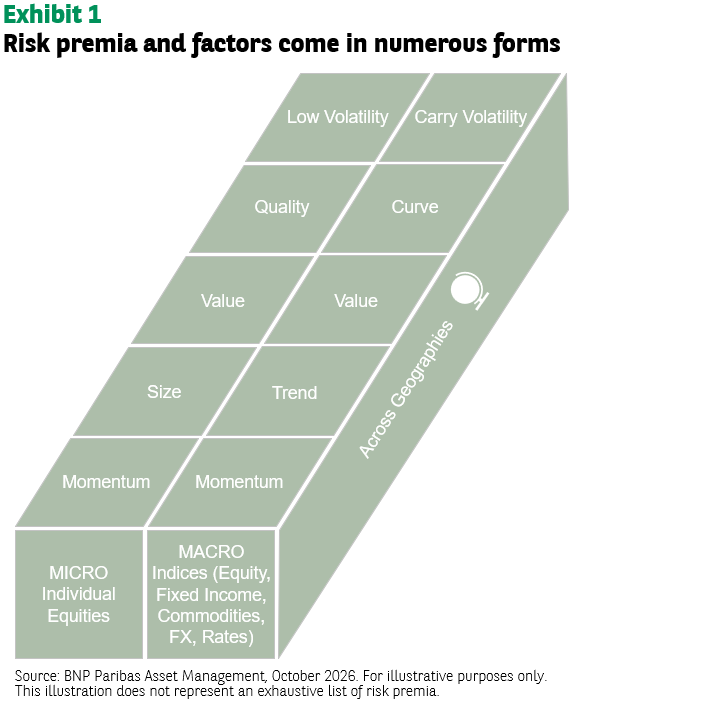
ETFs now offer investors access to systematic and index-based solutions that were previously only accessible to institutional investors or hedge funds.
Defined-outcome ETFs, also known as buffer ETFs, aim to deliver investors a predefined range of outcomes over a set period.
In this article, we present the potential benefits and drawbacks of both liquid alternative ETFs as well as defined outcome ETFs, which offer a structured way for investors to potentially shield against market losses while capping potential gains.
Liquid alternatives and alternative risk premia
The concept underlying alternative risk premia is the potential reward to an investor for taking on some form of risk. As the name suggests, this risk is alternative to traditional market risk or traditional beta in the sense that correlations across risk premia and asset groups tend to be low.
It tends to be structured in the form of long/short investments. The result is the potential for diversification benefits and, in turn, potentially enhanced risk-adjusted returns when combined in a single portfolio.
Alternative risk premia aim to provide positive, persistent return streams which can be generated using a systematic, rules-based approach. They have usually a low correlation with the underlying market from which they are generated.
Non-traditional investment techniques such as shorting and derivative strategies are employed to exploit them. Finally, an economic or behavioural rationale exists to explain why they could be expected to have a positive return over time.
Commonly used risk premia include:
- Momentum – The momentum factor refers to the tendency of winning stocks to continue performing well in the near term. Momentum is categorised as a ‘persistence’ factor i.e., it tends to benefit from continued trends in markets
- Size – The size factor is one of the most widely recognised investment themes built on the intuition that smaller companies, and by extension smaller market capitalisation stocks, may grow faster than larger peers thereby offering the potential for higher returns
- Value – The foundation of value investing is the notion that cheaply priced stocks outperform pricier stocks in the long term
- Quality – The quality factor aims to reflect the performance of companies with durable business models and sustainable competitive advantages
Liquid alternative and defined outcome ETF strategies
Our four ETF strategies aim to fulfil the core objectives of modern portfolio construction with diversified return sources, defined‑outcome risk control, income generation and long‑term robustness across market cycles.
This ETF range falls naturally into two distinct groups that address separate investor priorities:
Absolute return strategies
- BNP Paribas Easy Global Equity Long Short
- BNP Paribas Easy Managed Futures
Represented by a managed futures and a global equity long/short ETF, these funds’ objective is to deliver diversified returns that have the potential to support portfolios across various market cycles.
The managed futures strategy follows a proprietary, model-based, systematic trend‑following methodology across a broad universe of futures contracts including equities, rates, currencies and commodities. The funds employ derivatives and leverage to implement the strategy. Counterparty risk for derivative contracts is subject to rigorous risk management.
Empirical research shows that trend‑following futures exhibit persistently low correlations with global equity indices, typically below 0.25 and as low as 0.06 relative to the MSCI World Index.1
Through a continuous rebalancing of long and short exposures, the strategy seeks to capture persistent price trends while delivering the low‑correlation characteristics historically associated with commodity trading advisor approaches.
This provides diversification in a typical equity‑bond portfolio and lower sensitivity to equity market movements as measured by beta, volatility and drawdowns.
The global equity long/short strategy builds on the renowned MSCI Barra multi‑factor framework. It simultaneously holds long positions in securities that score strongly on a set of fundamental factors, and short positions in those with weak scores, thereby extracting alpha from both sides of the market while keeping a moderate net beta exposure.
The relevance of a multi-factor framework as a major source of alpha has been widely documented by academics since the 1970s, from the low-volatility anomaly to the Fama and French factor asset pricing model and beyond.2
The Barra factor framework, amongst the most renowned factor risk model, is widely adopted by practitioners; MSCI estimates that more than 80% of the top 50 hedged funds, asset managers, asset owners and insurers integrate the model in their investment and/or risk models.3
This framework has been leveraged through an exclusive partnership between BNP Paribas Global Markets and BNP Paribas Asset Management to build long/short portfolios for our investors.
The income-oriented family
- BNP Paribas Easy Equity Premium Income
- BNP Paribas Easy European Equity Buffer
This comprises the equity buffer and equity premium income strategies, which offer income or defined-outcome objectives using options.
The European equity buffer strategy blends a full‑market exposure to the Euro Stoxx 50 with a structured option overlay that protects a pre‑defined portion of the downside over a one‑year horizon and caps upside at a predetermined level.
As previously, these funds employ derivatives and leverage to implement the strategy. While counterparty risk for derivative contracts is subject to rigorous risk management it remains a risk factor for potential investors to take into account when considering investments in these strategies.
Although widely available to ETF investors in the US, this type of strategy remains new to European investors, and is offered on a European equity index for the first time by BNP Paribas.
Exhibit 2 below illustrates the payoff profile of a defined outcome ETF using a standard buffer structure. ETFs using the standard structure follow the performance of the Euro Stoxx 50, up to a cap while avoiding a certain percentage of the asset’s losses should it decline.
Defined outcome ETFs also forgo dividend payments – no dividends are paid. In this example, investors can gain no more than 23% over the defined year but are shielded from the index’s first 5% of losses, before fees. Performance will mimic the reference asset if it returns between zero and 23% in this example. That is, the buffer covers only the first 5% of losses for investors holding the ETF for the full outcome period.
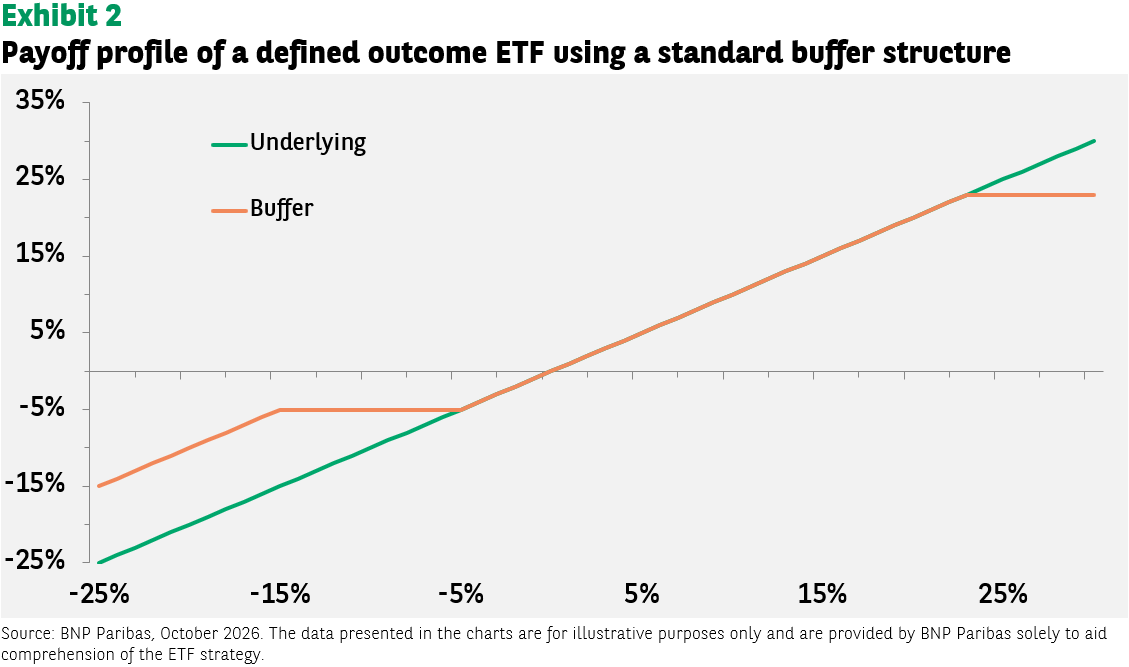
Source: BNP Paribas, For illustrative purposes only. The data presented in the charts are for illustrative purposes only and are provided by BNP Paribas solely to aid understanding of the ETF strategy
In contrast, the premium income ETF harvests premium from a high‑frequency, short‑dated and leveraged put‑writing programme on major equity indices (e.g. S&P 500, Nasdaq-100, EURO STOXX 50).
The collected premiums can be distributed on the relevant share classes, producing an equity‑linked income stream that is potentially less sensitive to interest‑rate movements than traditional fixed‑income solutions.
Academic and practitioner research is extensive in this area, and BNP Paribas’s own Quantitative Investment Strategies Lab has recently published a guide to volatility arbitrage trading and portfolio construction across asset classes.
The report “Every Vol, Everywhere, All at Once”4 shows that deep out-of-the-money put options with very short-term expiries of one to several business days offer attractive instruments to build income portfolios.
This research coincides with the exponential growth of the volumes traded on short-term options on the Chicago Board Options Exchange (CBOE): the number of contracts traded daily with less than one-week expiry increased six-fold since 2018 and now surpass the number of contracts expiring after one week (see Exhibit 3).
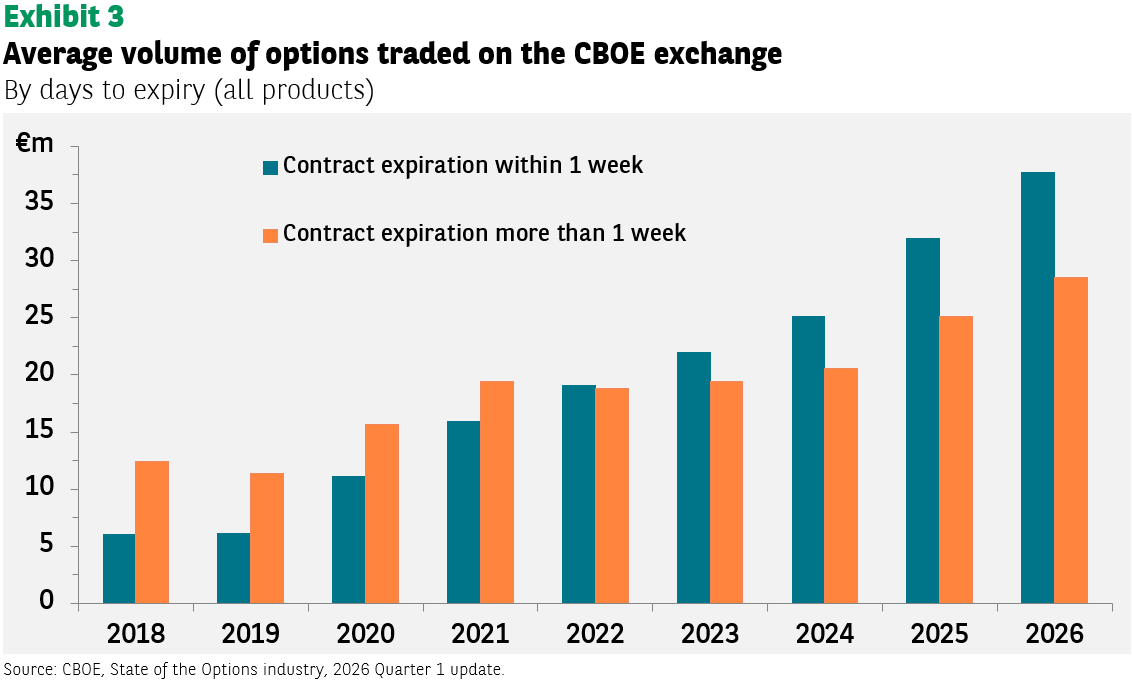
Based on this concept and available liquidity, the ETF strategy has the potential to lessen portfolio volatility by generating regular premium income, while the major risk remains extreme gap scenarios.
Conclusion
In practice, these new ETF strategies provide investors and allocators with a versatile set of building blocks.
While the strategies offer the potential for attractive returns, it is important to note that all investments carry risk. This includes the possibility that the investment may lose value, meaning investors may not recover the original capital invested in an ETF.
Defined‑outcome strategies such as buffer ETFs can play a complementary role by providing targeted downside protection within an equity allocation, helping investors manage drawdowns with greater predictability across market cycles.
Similarly, option‑based income strategies can support portfolio construction by generating a consistent premium‑driven cashflow stream, offering an additional source of return alongside capital appreciation, particularly in more range‑bound markets.
The exact weighting of each allocation should be calibrated to an investor’s specific objectives, risk tolerance and income requirements.
The synergy between BNP Paribas Global Markets’ quantitative acumen and BNP Paribas Asset Management’s fund‑structuring expertise has produced a range of ETF strategies that bring hedge‑fund‑style investment techniques into the regulated, liquid world of UCITS ETFs.
For professional investors seeking diversification beyond traditional market indices, these four ETF strategies represent a new, research‑backed option set that can be integrated into multi‑asset portfolios with the aim of achieving more resilient, risk‑adjusted returns across market regimes.
Finally, please note that this article is for informational purposes only. For a complete description of the funds’ objectives, risks, and charges, please refer to the current Prospectus and the Key Information Document (KID).”
[1] Cambridge Associates, Alternative Risk Premia Funds: An Attractive Diversifier, 2022
[2] Haugen & Heins, On the Evidence Supporting the Existence of Risk Premiums in the Capital Market, Wisconsin University, 1972. Fama & French, A five-factor asset pricing model, Journal of Financial Economics, 2015
[3] MSCI, December 2025
[4] Julien Turc et al., Every Vol, Everywhere, All at Once, BNP Paribas, 2026


