
In 2026, BNP Paribas Asset Management partnered with Investors for Purpose to research investor attitudes to green bonds. The findings show a challenge for asset managers to counter the persistent myths about an instrument which combines investment objectives with decarbonisation of the economy.
In our view, bonds remain a vital part of any long-term investment strategy, as well as having a key role in liquidity management for institutional investors. Additionally, as green bonds direct capital towards environment-friendly projects, they are a way for investors to meet their investment objectives while also helping them reach their decarbonization objectives.
This dual purpose was reflected in our research when we asked asset owners what attracted them to green bonds.
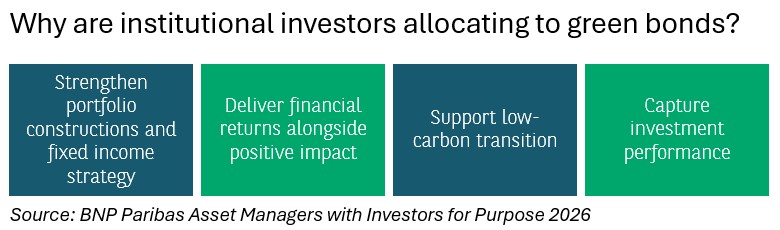
Their answers to this question show that investors understand how green bonds may help create stronger portfolios and are not just focused on environmental arguments. Strengthening portfolios was the reason given for investing in green bonds by the largest number of respondents, which suggests that there is already an understanding that including green bonds could help to create a more resilient portfolio. The fact that investors mentioned capturing investment performance a separate benefit also shows that they value the financial merit of green bonds outside of their decarbonization benefits.
Clearly, there is an appetite for green bonds amongst UK investors, but this isn’t being reflected in investment levels. We haven’t seen the same level of appetite for green bonds in the UK that we have from European and Asian investors, for example, where green bonds have seen much higher levels of investment.
There are signs this could be changing. In July, the Boarders to Coast Global Sustainable Bond fund launched with £1.35 billion from local government pension funds. But overall, UK investors in particular seem hesitant to commit significant levels of investment to green bonds.
What’s holding investors back?
Our research, in partnership with Investors for Purpose, aimed to discover what was stopping institutional investors from investing in green bonds. We identified six key concerns.
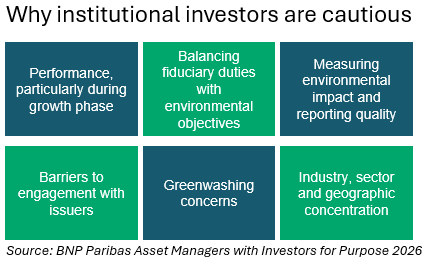
While we don’t dismiss these objections, some of the points raised don’t reflect the reality, reiterating persistent myths that surround green bonds.
Perceptions of a small, concentrated universe don’t match the mature market that has evolved since the first green bonds were launched over 10 years ago. The overall green, social and sustainable bond market has seen growing numbers of issuers every year and is now valued at over US$4 trillion, larger than the entire euro-denominated investment grade bond market. (Source: BNP Paribas Asset Management, Bloomberg as at 30 September 2026.)
It is now a well-diversified universe with 40% exposure to credit, providing a better balance between rates and spreads compared to the conventional fixed income universe. Geographical diversification is increasing with rising issuance from emerging markets and Asia, further expanding the opportunity set.
Green bonds are a dynamic source of investment opportunities, providing a similar risk-return profile to the conventional bond market whilst offering the granularity to build exposure with specific risk profiles alongside enhanced environmental impact.
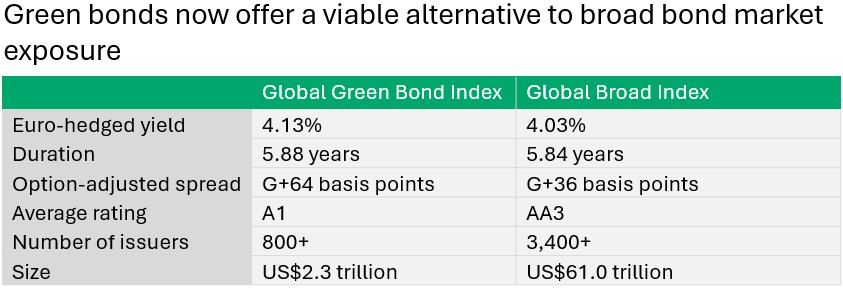
Source: BNP Paribas Asset Management, Bloomberg, 30 September 2026.Indices: ICE BofA Green Bond Index and ICE BofA Global Broad Market Index. For illustrative purposes only.
Concerns about performance similarly fail to reflect the current state of play. Over the past three years the ICE BofA Green Bond Index has demonstrated competitive risk-adjusted returns. It has achieved comparable performance to the ICE BofA Global Corporate Index, while significantly outperforming the ICE BofA Global Broad Market Index, with the lowest volatility of the three. Contrary to perception, green bonds offer potentially competitive returns whilst keeping volatility lower than conventional bonds.
Performance comparable to conventional peers
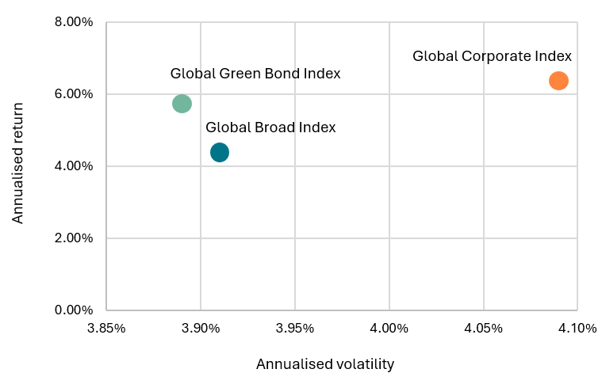
Source: BNP Paribas Asset Management; Broadridge; Morningstar Direct, Bloomberg. As of 29 May 2026. Indices: ICE BofA Green Bond Index and ICE BofA Global Broad Market Index. For illustrative purposes only. Past performance is not a guide to future returns.
Respondents raised concerns about the ability of fixed income investors to engage with issuers, but the fact is that investors can and do engage regularly. Large investors like BNP Paribas Asset Management hold equity and bonds with many issuers, allowing them to engage on different levels, and engagement before bonds are issued – to clarify goals and reporting standards – is also a powerful tool. Issuers need to put a lot of effort into structuring a green bond and are therefore very open to this type of dialogue.
Moreover, they are under larger scrutiny to show the impact of their green bond, which is further stimulated by international guidelines and green bond frameworks, making it likely they will have more data available that could feed into fruitful engagement. And if engagements fail, investors can and will disinvest.
There is ample evidence to make the case, but it up to us to make it. We believe that there is more to be done to allay the concerns we discovered through our research. These include:
- Consistent reporting standards –The industry needs to develop clearer expectations and guidance for asset managers and issuers on reporting that can be used for decision-making on bond allocation, focusing on consistency and comparability while avoiding unnecessary reporting burdens.
- Highlight the breadth of opportunities – Issuers and asset managers need to educate asset owners on the range of products available in the green bond space, and how they can be integrated with conventional bonds to create a unified market.
- Demonstrate financial characteristics – More needs to be done to provide practical, evidence-based examples that bring together market data with existing data on environmental outcomes that help investors understand the positive performance of green bonds relative to the broader bond market.
- Strengthen public policy engagement – A coordinated approach to developing stable, credible frameworks for long-term investment in the energy transition will help to establish green bonds as a key asset class for decarbonising the economy.
Coordinated approaches have the best chance of success
We believe that asset managers, issuers and regulators need to work together to combat the myths that are standing in the way of asset owners committing to green bonds. Our collaboration with Pensions for Purpose shows how we can combine efforts to find out more about what investors want from us. The next step is to turn this into coordinated action.
Green bonds have several advantages that mean investors should be considering adding them to their fixed income portfolio. Aside from the obvious environmental impacts, they have a favourable risk-return profile that’s comparable to other types of bonds and could provide important diversification benefits.
The specific nature of green bonds means that issuers are open to engagement from investors, helping to align the goals of the bond with investors’ objectives. And the broad and diverse universe means that investors have a range of options to match their needs. The next step is to make investors more aware of the meaningful diversification and financial merit that green bonds could offer.
The report Green bonds: opportunities, challenges and future priorities published by Investors for Purpose can be found here.


