
What do you need to know?
US inflation rose by 0.4% in October, more than the 0.3% the market had been expecting. Though it was a slowdown from September’s 0.6%, the data renewed expectations that the Federal Reserve may raise interest rates in December. An annualised figure was not released due to the government shutdown in October 2025. Core inflation, excluding food and energy prices, increased by 0.3%, for the third consecutive month. Separately, the MSCI World Index rose 2% in the week to Thursday’s close with the Nasdaq rebounding 4% from the previous week’s fall*.
*In US dollar terms. Source: FactSet, data as of 12 November 2026
Around the world
China’s trade surplus exceeded $1 trillion in the first 10 months of 2026, well above the $964.8 billion recorded in the same period last year, driven by global demand for artificial intelligence-related products. The figure puts the country on track to reach a record level for the full year. Elsewhere, eurozone GDP grew 0.4% in the third quarter, the official second estimate showed, down from 0.6% in Q2. In addition, the UK economy grew 0.7% on a quarterly basis in Q3, its fastest pace for more than two years.
Figure in focus: 35%
A new global pledge aims to increase the use of electricity to 35% of total energy consumption by 2035, up from around 23% today. The “35 by 35” target was officially endorsed at the United Nations climate change conference COP31, taking place in Turkey from 9-20 November. The goal includes increasingly moving from fossil fuels to electricity for sectors including transport, buildings and industry, to reduce carbon emissions and costs, as well as enhancing energy security.
Chart of the week
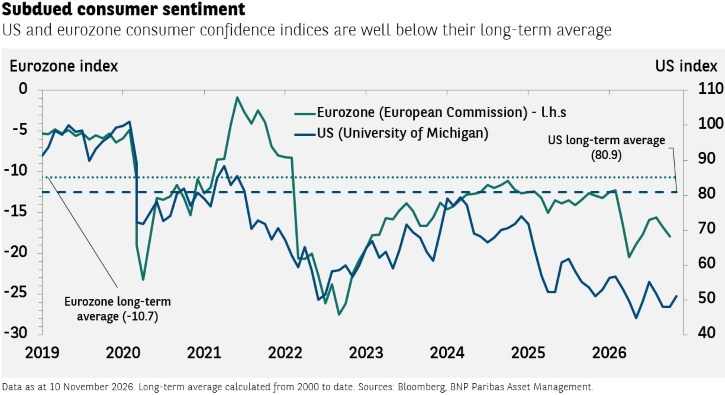
US consumer confidence has recovered slightly in November, according to the University of Michigan’s initial estimate – though the index has fluctuated at low levels for a year. Meanwhile, the eurozone index has failed to recover sustainably since its drop in March and April. Although consumer confidence is usually only loosely correlated with spending, purchasing power erosion due to rising energy costs is sufficiently pronounced to modify consumption habits. Additionally, widespread uncertainty is expected to deter households from major spending.
Words of wisdom: Singles’ Day
Singles’ Day started in China as a celebration of being single, taking place on 11 November – the date was chosen as the numerals represent individuals. It has grown into one of the largest global online shopping events, with retailers offering sizeable discounts to rival those of Black Friday and Cyber Monday. Retail sales around Singles’ Day are viewed as a barometer of China’s economic activity – this year sales rose 4.8% to 1.78 trillion yuan (US $267 billion) from the year before, according to reports citing data provider Syntun.
What’s coming up?
On Monday, the eurozone reports industrial production data, followed by the US on Tuesday. The Reserve Bank of Australia publishes the minutes of its last interest rate-setting meeting on Tuesday. On Wednesday, the eurozone and UK each publish their latest inflation data, while the Federal Reserve issues the minutes of its last monetary policy meeting. It opted to keep rates on hold at 3.75%-4.0% in October.