
Absolute Return Strategy
An investment strategy aims to generate positive returns in both up markets and down markets. They are contrasted with investment strategies that aim to beat an investment index or peer group – these can still be considered successful if they deliver a negative return that beats this target. Absolute return strategies aim to always deliver a positive return.
Accruals
Accruals are non-cash earned revenues and incurred expenses that impact the income statement but are not yet reflected into cash movements. They also affect the balance sheet, via liabilities and non-cash-based assets used in accrual-based accounting. These accounts include, among others, accounts payable, accounts receivable, goodwill, future tax liabilities and future interest expenses. Although accrual accounting has the advantage of encompassing forward elements of the activity, it also leaves room for accounting abuse or analysis bias. Accruals over Assets can then be used as a proxy for earnings quality and are calculated as follows:
Accruals over Assets = (Net Income – CFO) / Total Assets
Please note that this calculation does not apply for financials given that virtually no cash flow is retained.
Active Investment
An investment approach where an investor makes positive decisions about which securities to invest in, based on in-depth research, market forecasting and the expertise of the management team. It is usually contrasted with passive management, where an investor invests in line with market movements, without making any active investment decisions.
Alpha
In simple terms, alpha represents the value that an investment manager adds – or subtracts – beyond just following the market trends. It shows whether an investment strategy has outperformed or underperformed the market after accounting for risk. Positive alpha means the investment has done better than expected, delivering higher returns than the market would suggest; Negative alpha indicates it has performed worse than the market. It is usually expressed as a percentage: an alpha of 1.00 indicates that a fund has outperformed its benchmark by 1%.
Alternative Investment
Investments considered outside of the traditional asset classes of stocks, bonds and cash. This includes things like real estate, commodities, options and financial derivatives. Hedge funds often invest in alternative assets as a way of delivering returns that are uncorrelated to the traditional investment assets.
Alternative Investment Market (AIM)
A part of the London Stock Exchange (LSE), with an associated index. This is a market for where smaller, growing firms can list and enjoy more regulatory flexibility than the main London Stock Market.
Annual management charge (AMC)
A fee charged by fund managers to investors to cover costs of the day-to-day management of an investment portfolio. It is usually based on a percentage of the investors assets in the fund. A fund’s stated AMC doesn’t cover all the costs, and there may be additional charges on top of this.
AMCs can vary between funds, Investors should consider the impact of fees on their investment, while also considering that the cheapest is not always the best.
Annuity
An annuity is a financial product that provides a guaranteed income in exchanges for a set amount. They are typically used by people retiring to provide an income for the rest of their life.
Anti-dilution levy
This liquidity management tool is a fee that is paid to the fund by a unit-holder or shareholder at the time of a subscription, repurchase or redemption of units or shares, that compensates the fund for the cost of liquidity incurred because of the size of that transaction, and that ensures that other unit-holders or shareholders are not unfairly disadvantaged.
Arbitrage
Arbitrage usually refers to a financial strategy designed to profit from a discrepancy in the market. The arbitrage opportunity occurs when short term pricing inefficiencies are detected. A typical arbitrage would be to simultaneously buy and sell similar financial instruments in different markets to capture an abnormal price difference.
Ask / Bid price
The lowest price a seller is willing to sell a security for / against the highest price a buyer is willing to pay for a security.
Asset Allocation
The broad name for the process of balancing the risk and rewards from different investments and deciding how much to invest in different assets. Asset allocation decisions will depend on an investor’s tolerance for risk, their particular goals and their investment time frame. Asset allocations can be adjusted over time in response to information that affects the value of different assets or in line with an investor’s goals.
Asset Backed Security (ABS)
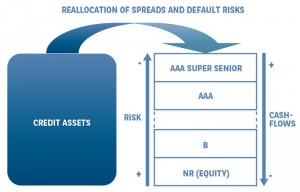
Asset Backed Securities (ABS) are a type of bond which is backed by specific assets as collateral. The collateral typically used to back ABS include: auto loans, credit card receivables, housing loans or student loans.


Socially responsible investment (SRI)
A socially responsible investment (SRI) is an investment in companies based on social and environmental criteria. Socially responsible investing favours companies engaging in environmental sustainability and clean energy for example, while avoiding companies with a poor environmental record or companies promoting addictive substances such as alcohol or tobacco.