
The world of finance in two minutes. This week:
Global stocks reached record highs last week in expectation of the US and Iran’s peace deal. The Dow Jones Industrial Average, Euro Stoxx 600 and Nikkei 225 closed at record levels as oil prices fell, and inflation concerns eased. However, while the Federal Reserve held interest rates at 3.50%-3.75% – the first meeting under new Chair Kevin Warsh – it indicated a possible rate hike before the end of this year. Elsewhere, Eurozone annual inflation rose to 3.2% in May from 3.0% in April while core inflation, excluding energy, food, alcohol and tobacco, rose to 2.6% from 2.2%.
Around the world
The Bank of Japan raised its benchmark interest rate by 25 basis points to 1% – the highest level since 1995. It said that higher oil prices were passing through to businesses and could increase consumer prices. Japan’s annual inflation rate rose slightly to 1.5% in May from 1.4% in April, data released later in the week showed, while core inflation, excluding fresh food, held steady at 1.4%. Elsewhere, the Bank of England kept interest rates on hold at 3.75%, though two of the nine policymakers voted for a 25-basis-point rise, as UK annual inflation unexpectedly remained unchanged at 2.8% in May.
Figure in focus: 0.6%
China retail sales fell for the first time in over three years, putting pressure on its government to consider fresh stimulus to boost spending. Retail sales fell 0.6% in May from a year earlier – analysts had expected the figure to be flat on the previous month. Urban fixed-asset investment, including real estate, also fell more than expected, underlining continued weakness in the property market.
Chart of the week
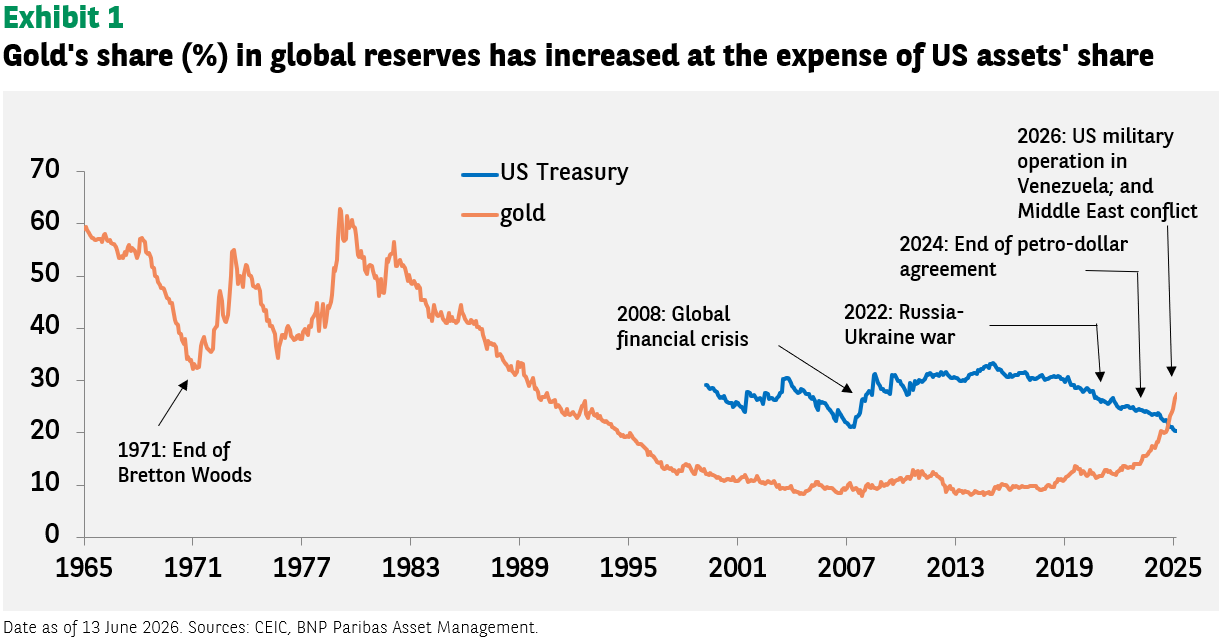
Many central banks are increasing their gold reserves at the expense of US dollar assets. Investors also tend to trust gold because it is a supranational asset that is not tied to the economic policy or political system of any one country. As a result, the precious metal will likely remain a hedging tool against economic and geopolitical shocks. China has been actively accumulating gold in its foreign reserves and developing its own bullion ecosystem by offering some trading partners who receive renminbi revenues the option of converting some of those proceeds into gold.
Words of wisdom
AMOC: The Atlantic Meridional Overturning Circulation is a system of ocean currents driving warm water north and sending cold water south in the Atlantic Ocean. The AMOC plays a critical role in regulating climate as it transfers carbon dioxide from the atmosphere to the ocean. Recent research suggested the AMOC could weaken much more by the end of this century than previously thought, which could raise sea levels causing flooding, threaten food security and bring colder, harsher winters. However, experts said a lack of data means it is difficult to ascertain the extent to which the AMOC has weakened.
What’s coming up?
On Monday, Canada publishes its latest inflation numbers while Tuesday sees several composite Purchasing Managers’ Indices issued, including those covering Japan, India, the Eurozone, US and UK. On Wednesday, Germany posts its closely watched Ifo Business Climate index; the measure rose in May, after falling to a six-year low in April. On Thursday, the US reports its final estimate for first quarter economic growth; the last estimate showed the world’s largest economy had expanded by an annualised rate of 1.6% in Q1, up from 0.5% in Q4.


