
Graph of the Week – Europe’s growth-inflation dynamic improves

The eurozone economy trailed the US during the post-Covid recovery, with US growth clearly outpacing that in the eurozone. More recently, however, the gap has narrowed, with the growth-inflation mix in the eurozone catching up.  

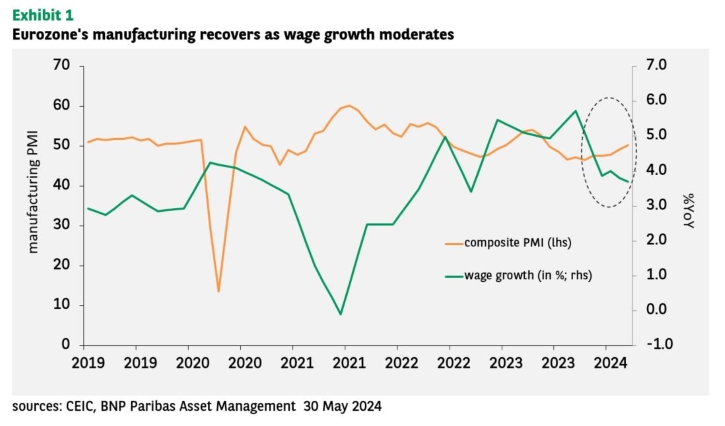
Using the purchasing managers index of the manufacturing sector as a proxy for the wider economy, and setting that against pressures for higher wages, recent data shows the eurozone manufacturing PMI recovering on the back of moderating wage growth (see exhibit 1). The manufacturing PMI rose to 47.3 in May from 45.7 in April, marking the highest reading since March 2023.

With labour market conditions a key variable for the European Central Bank’s assessment of inflationary pressures, and moderating wage gains boding well for Europe’s inflation outlook, the market’s view that the ECB will cut interest rates at a faster clip than the US Federal Reserve appears justified. 
Important information

Please note that articles may contain technical language. For this reason, they may not be suitable for readers without professional investment experience. Any views expressed here are those of the author as of the date of publication, are based on available information, and are subject to change without notice. Individual portfolio management teams may hold different views and may take different investment decisions for different clients. This document does not constitute investment advice. The value of investments and the income they generate may go down as well as up and it is possible that investors will not recover their initial outlay. Past performance is no guarantee for future returns. Investing in emerging markets, or specialised or restricted sectors is likely to be subject to a higher-than-average volatility due to a high degree of concentration, greater uncertainty because less information is available, there is less liquidity or due to greater sensitivity to changes in market conditions (social, political and economic conditions). Some emerging markets offer less security than the majority of international developed markets. For this reason, services for portfolio transactions, liquidation and conservation on behalf of funds invested in emerging markets may carry greater risk.

Back to Top