
What do you need to know?
The Federal Reserve decided to keep interest rates on hold at 3.75%-4% by a vote of 10-2, with two of the 12-member committee favouring a 25-basis-point rise. The Fed stated that while inflation remains high, “the accumulation of more information” is first needed to guide its return to the 2% goal – though expectations of a further rate hike by year end remain strong. Meanwhile, an advance estimate for US GDP growth in the third quarter showed expansion at an annualised 3.4%, up from Q2’s 2.2% and above expectations of 3.2%.
Around the world
The European Central Bank voted to keep interest rates steady last week, despite annual inflation accelerating to 3.8% in September, a three-year high. The ECB noted that rising energy prices are likely to drive up inflation and lower growth within the region. The eurozone economy grew 0.4% on a quarterly basis in Q3, a slowdown from Q2’s 0.6%, according to official data released after the ECB meeting. Elsewhere, the Bank of Japan kept rates unchanged at 1.25% and said underlying inflation had reached its 2% target, the first time since the goal was set in 2013.
Figure in focus: 37%
Foreign direct investment increased by 37% globally in the first half of 2026, compared to the average half-year level in 2025, according to the United Nations’ Trade and Development arm. The rise was largely driven by developed economies which saw investment flows rise by more than 70% in the first half of 2026. However, overall activity weakened, with the number of new projects falling by 15% and international project finance deals declining by 11%. The slowdown in activity reflects global uncertainty over geopolitical tensions, energy prices and supply chain disruptions, the UN said.
Chart of the week
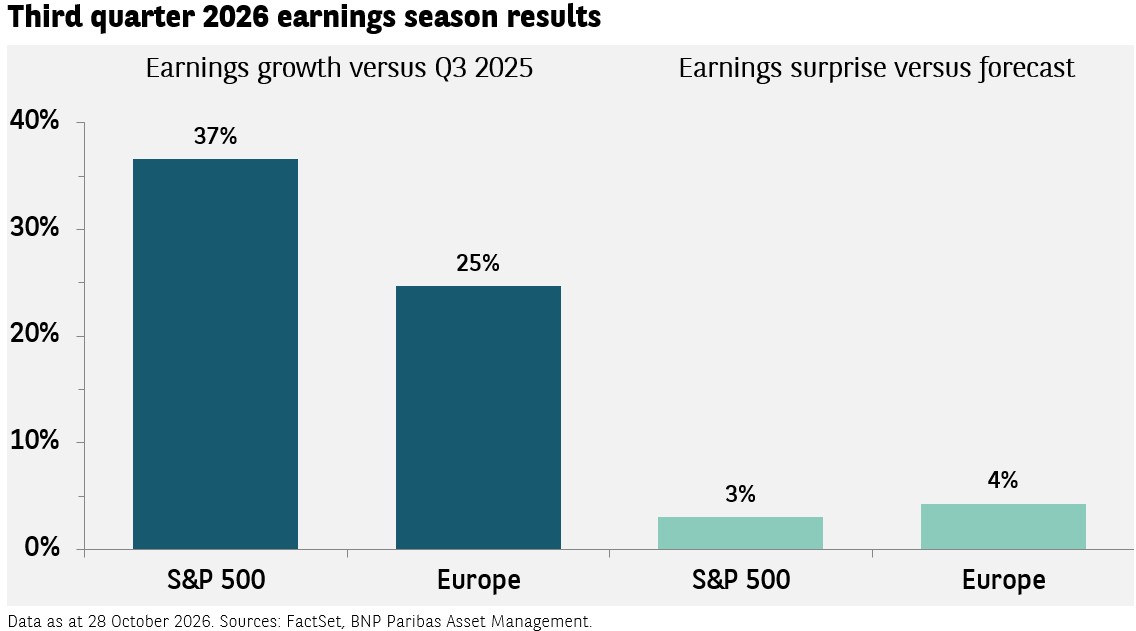
About a third of US and Europe-listed companies had released their third quarter earnings as of last week. Things are going well. In the US, earnings have risen by 37%, though a big contributor to that growth is the technology sector. Excluding technology stocks, the earnings growth rate is a still good 17%. In Europe, earnings are up 25%. Investors also look at how much better or worse the results are compared to what was expected. So far, earnings have surpassed expectations by 3%-4%, in line with historical averages.
Words of wisdom: Big Bang
The deregulation of the London Stock Exchange, referred to as the Big Bang, marked its 40th anniversary last week.On 27 October 1986,the open outcry trading floor was replaced by electronic order books, and fixed broker commissions were abolished, leading to a sudden surge in trading volumes and lower costs for investors. This transformed London into a leading global financial centre. As investment from the US and Asia flowed into London, the Big Bang caused a ripple effect across Europe with the region accelerating the pace of modernising its own trading models.
What’s coming up?
On Tuesday, the Reserve Bank of Australia convenes to set interest rates. Wednesday sees the eurozone release a flash estimate for October’s inflation rate. Several final Purchasing Managers’ Indices for October are issued on Wednesday covering the eurozone, China, UK, and the US. The Bank of England meets to set interest rates on Thursday. On Friday, the US releases its latest jobs data.


