
Investment Outlook – Asset class views for 2026

Investors will need to be flexible and selective in 2026 as markets adapt to greater economic fragmentation around the world. Bonds are poised to benefit from rate cuts, particularly in the US and Europe, but remain vulnerable to rising budget deficits. Credit is supported by the economic and policy backdrop. In stocks, tech company earnings are expected to grow robustly as AI fuels capital spending. Strong tech sectors should benefit selected emerging markets, with further support from lower US bond yields and a weak dollar.

This article is part of our 2026 Investment Outlook.

Here is a rundown of our asset class views: 
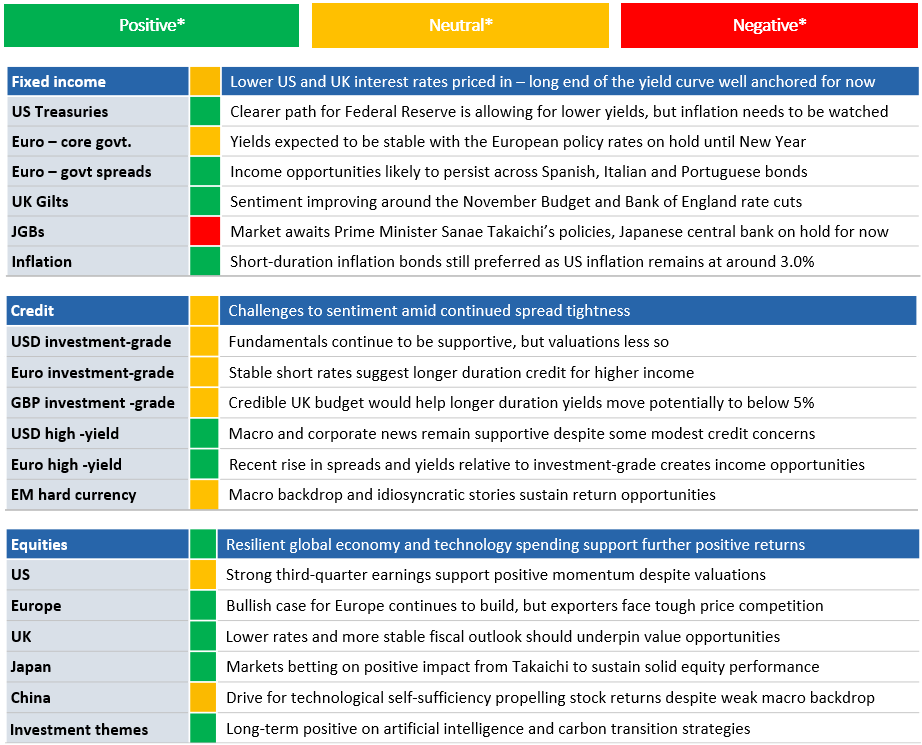
*Traffic lights indicate expected return over a three-to-six-month period relative to long-term observed trends. These asset class views draw on investment team views and are not intended as asset allocation advice. The views expressed are valid at the time of writing. Individual investment teams may hold different views and make different investment decisions.

Important information

Please note that articles may contain technical language. For this reason, they may not be suitable for readers without professional investment experience. Any views expressed here are those of the author as of the date of publication, are based on available information, and are subject to change without notice. Individual portfolio management teams may hold different views and may take different investment decisions for different clients. This document does not constitute investment advice. The value of investments and the income they generate may go down as well as up and it is possible that investors will not recover their initial outlay. Past performance is no guarantee for future returns. Investing in emerging markets, or specialised or restricted sectors is likely to be subject to a higher-than-average volatility due to a high degree of concentration, greater uncertainty because less information is available, there is less liquidity or due to greater sensitivity to changes in market conditions (social, political and economic conditions). Some emerging markets offer less security than the majority of international developed markets. For this reason, services for portfolio transactions, liquidation and conservation on behalf of funds invested in emerging markets may carry greater risk.

Back to Top