
By Daniel Morris, Chief Market Strategist
Emerging market equities are having a good run. They have easily beaten developed markets year to date, and since the beginning of 2025, returns are about twice those of the MSCI World index, in US dollar terms.
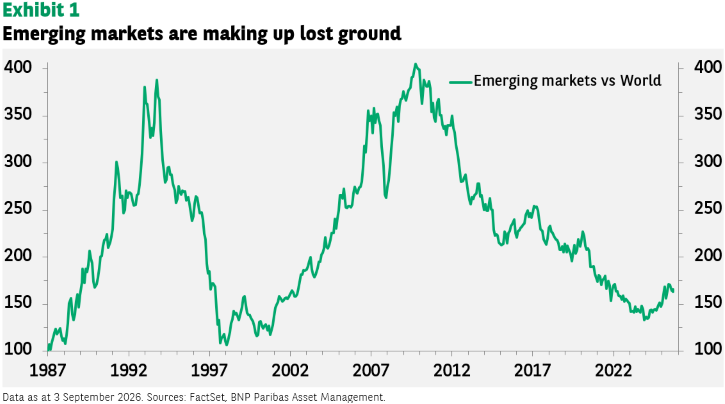
This follows, however, an extended period of underperformance that began in 2010. The question for investors is whether the recent upswing is temporary or will be more prolonged like the ones beginning in 1987 and 2001 (see Exhibit 1).
To help answer it, it is helpful to look at what has driven the superior returns. There have been two distinct periods of outperformance of emerging market equities (see Exhibit 2).
The first, in 2025, was primarily driven by Chinese stocks in the Broadline Retail industry (which includes online retailers), and Interactive Media and Services (which includes search engines, social media and networking platforms). These stocks have lagged sharply this year. In the chart below, we have grouped these industries along with Software & Services in a broad ‘tech software’ category.
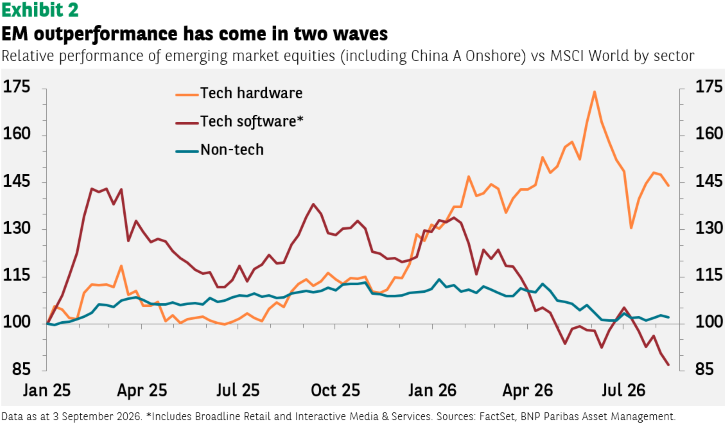
In the second period, the lead was taken by technology hardware and semiconductor stocks, which, despite the sell-off that began in late June, are still up around 45% year to date.
We have included the China A Onshore index in the ‘tech hardware’ calculation as it includes some of the major domestic Chinese artificial intelligence and robotics companies.
The rest of emerging market stocks have performed largely in line with their developed market peers.
Viewed through this lens, the sustainability of EM outperformance depends on either a rebound in domestic China internet retail or interactive media stocks, or continued gains in tech hardware and semiconductor stocks.
A key advantage for Chinese software stocks is valuations, where multiples are roughly half those of the US counterparts. They have often traded at a discount, however, and as always, low valuations do not guarantee superior future returns.
The outlook for hardware and semiconductor stocks is arguably better as it is premised on continued robust earnings growth. Earnings for the last season were strong and generally exceeded expectations.
Forecasts are being revised upwards. While there are justifiable questions about the medium-term profitability of the massive capital expenditures of US hyperscalers, in the near term it potentially does not matter to the EM tech companies which are the primary beneficiaries.
The hyperscalers are likely to continue spending for the time being, regardless of the market’s assessment of its wisdom.
For further analysis, please see the article Picks, shovels and deep value: A re-examination of emerging market equities by Zhikai Chen, our Head of Asia and Global Emerging Markets Equities.
Data sources: Bloomberg, FactSet, BNP Paribas Asset Management as of 3 September 2026 (unless otherwise stated). Past performance should not be seen as a guide to future returns.


