
- Increased market volatility has created a challenging environment for fixed income investors
- An active absolute return approach could potentially help investors navigate uncertainty through its global unconstrained approach and flexible duration range
- This could potentially suit investors who are aiming to generate positive returns with a focus on downside protection
By James McAlevey, Head of Global Aggregate and Absolute Return and Vicky Browne, Investment Specialist at BNP Paribas Asset Management
Fixed income investors have faced considerable volatility in markets in 2026, driven by a combination of geopolitical tensions, rising inflation and higher levels of issuance.
Against this backdrop, we believe there is potential value in an absolute return approach – where the aim is to produce positive, stable returns over time, in all market conditions with a focus on downside protection
Governments and companies are projected to borrow a massive $29 trillion from bond markets in 2026 – some 17% more than in 2024, according to the OECD.1
Within that, just nine companies – major players in artificial intelligence – are expected to issue $1.2 trillion of corporate bonds between 2026 and 2030 to fund their capital expenditure needs.
We are seeing a long-term transformation of the global economy driven by AI – from vast infrastructure investment to the potential for efficiency gains across a wide range of sectors, and the bifurcation between leaders and laggards of the AI-driven economy.
While we believe there is significant potential for long-term productivity gains, the demand for power, hardware and capital expenditure is reshaping growth and inflation dynamics, which has an impact on fixed income markets. Higher levels of issuance have pushed up yields and at times caused market turbulence.
The end of the bond backstop
Other geopolitical factors have also driven yields higher this year. In July 2025 the US House of Representatives passed the ‘One Big Beautiful Bill’, a massive tax and spending package that the Congressional Budget Office estimated would add $3.8 trillion to the fiscal deficit – causing US Treasury yields to spike.
Meanwhile that same month, Germany’s 10-year Bund yield hit its highest level since May 2011, Japan’s 30-year yield reached an historic high and UK gilts surged 35 basis points in a single week.These were not isolated events, but rather the bond market pricing in fiscal risk without the safety of a central bank backstop to absorb the pressure.
Since the era of quantitative easing ended, central banks have reduced their bond purchases, meaning they are no longer acting as a safety net – and the market is increasingly reliant on more price-sensitive investors.
Central banks themselves have also contributed to some of the volatility we have seen in fixed income markets this year.
The yield on 30-year US Treasuries surged to a 19-year high of more than 5.2% after the Federal Reserve’s 29-30 July meeting left investors scratching their heads over the future direction of rates. The Fed’s limited communications about its outlook, combined with the prospect of higher inflation as the Middle East crisis continued to squeeze oil supply, added another layer of complexity for bond market investors.
Amid this uncertainty over monetary policy and inflation, there is scope for credit spreads to widen – perhaps significantly. Against this backdrop, fixed income investors could potentially benefit from the freedom to actively navigate markets and potentially even take short positions in the asset class.
That could include taking a measured but broad approach across government and corporate bonds, as well as developed and emerging markets, or by adjusting duration in their portfolios, to aim to position themselves to benefit from rising yields as well as falling yields.
Asset class correlation
The traditional relationship between bonds and equities is also being challenged. For decades, investors relied on a relatively predictable relationship between the two asset classes, viewing fixed income as a potential defensive cushion against any falls in the equity market. However, fixed income and equity markets are now moving in the same direction much more often than was the case in the previous 20 years.
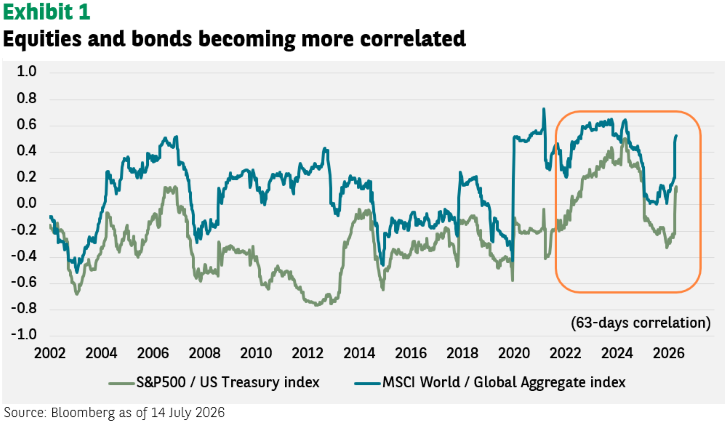
This may be a result of markets being more focused on inflation, against a backdrop of growing public debt ratios and solid corporate balance sheet fundamentals, but it may also mean portfolio diversification is not as straightforward as simply allocating between equities and traditional index tracking bond strategies. Therefore, investors may potentially seek to shift towards a more active investment approach to take account for the changing risk characteristics of blending bonds with stocks.
Geopolitical instability remains a primary threat to portfolio stability, but also a source of attractively priced opportunities. For instance, the Middle East conflict already has, and could further continue disrupt energy supplies, triggering a surge in prices and a return of stagflation concerns. Such a scenario could potentially drive credit spreads wider, squeezing corporate profit margins and weakening the consumer.
An active absolute return strategy can implement specific defensive overlays for scenarios such as these. For example, an overweight exposure to European inflation and short exposure to European investment-grade excess returns could potentially help act as a buffer, diversifying other positions in the portfolio, and helping to protect the strategy during geopolitical crises.
The need for flexibility
In an era defined by fiscal uncertainty and technological upheaval, the ability to move freely across markets without being tied to benchmarks is not just an advantage – we believe it is a necessity for the prudent investor.
Amid geopolitical and macroeconomic developments, the energy shock resulting from the Middle East war, AI capital demands and the corresponding large levels of sovereign bond issuance, we believe that fixed income volatility is here to stay.
An absolute return approach, via a diversified fixed income portfolio, has in our view the potential to perform better across different economic scenarios and could suit investors who are aiming to generate positive returns while mitigating risk.


