Stubbornly high inflation and resilient growth in the US have raised market expectations that the Federal Reserve will begin cutting interest rates months after the European Central Bank. The prospect of widening interest rate differentials has contributed to US dollar strength against the euro and other major currencies. But we do not see significant scope from here for additional central-bank-induced repricing in favour of the US dollar.
While in the short run, the euro may weaken further against the dollar, we believe it unlikely that the EUR/USD exchange rate will hit parity this year. Here’s why:
- Interest rate differentials, central bank policy rates, and market concerns about US trade relations after the presidential election are likely to be modestly supportive of the dollar for the rest of this year. However, with the market currently priced for about 70 basis points in rate cuts by the ECB and 40bp in cuts by the Fed by year-end, we do not see large scope for further central bank repricing in favour of the USD.
- Economically, the eurozone looks to be picking up in the second quarter, while the peak in US exceptionalism appears to be either close or behind us, so there is no obvious near-term economic catalyst for USD outperformance.
- There has been a strong consensus in favour of the dollar. The market has become quite long the dollar, so stretched positioning is likely to be a headwind for further USD strength.
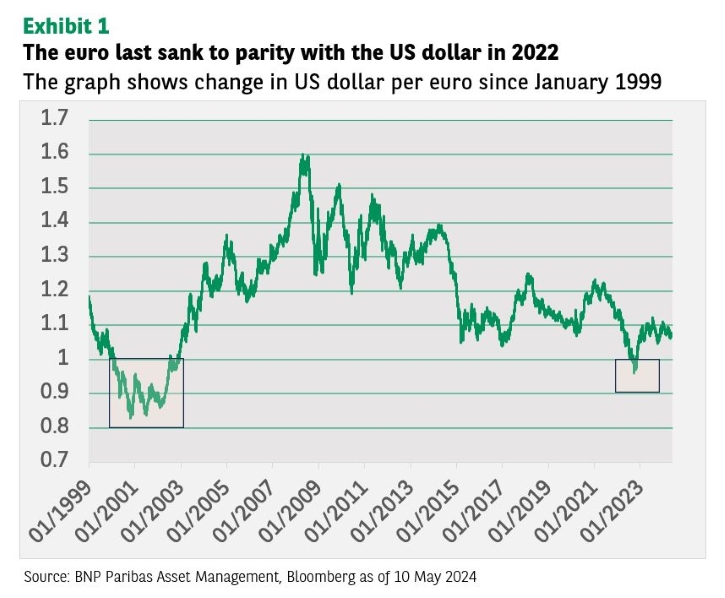
In our view, one catalyst that would make EUR/USD parity more likely would be a significant increase in energy costs. As we saw in 2022, when the euro last dropped to parity with the dollar, higher energy prices lead to a meaningful deterioration in the eurozone’s terms of trade; a worsening trade balance can weigh heavily on the euro.
The euro is not alone among the major currencies in being vulnerable to higher energy prices, whereas they are beneficial for the USD since the US is now a net fossil fuel exporter.
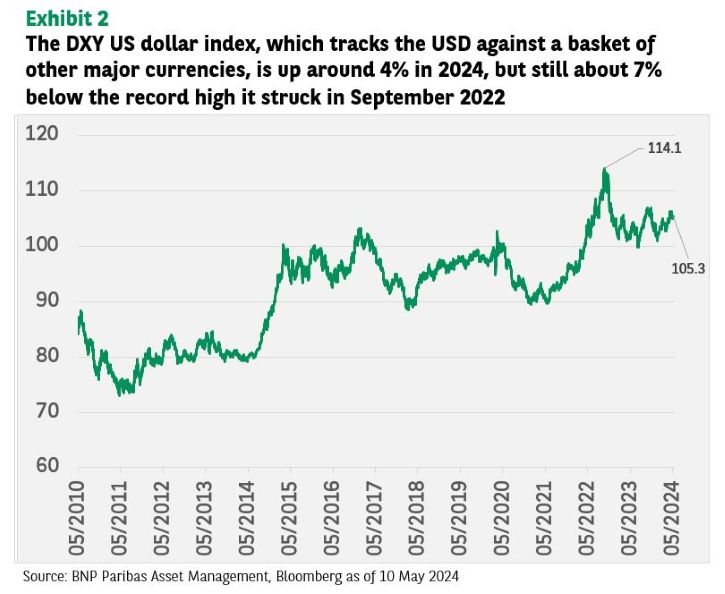
This is reflected in the performance of the DXY dollar index, which tracks the USD against a basket of other major currencies. It is up by around 4% so far in 2024 — which is about 7% below the record high it struck in September 2022 at the peak of the energy crisis.