
What do you need to know?
Renewed Middle East hostilities have driven energy prices higher once again. With both the US and Iran engulfed in fresh military strikes, oil prices rose to a one-month high, while markets felt the brunt of the collapsed truce. Later in the week, concerns emerged over the continued momentum and exuberance around artificial intelligence stocks. Over the week to Thursday’s close, the MSCI World index, the US’s blue-chip S&P 500 and MSCI Europe were flat, while the tech-heavy Nasdaq and Japan’s Nikkei each fell 1%.1
Around the world
US inflation fell further than anticipated in June, with the annual rate coming in at 3.5%, official data showed. This was down from May’s 4.2% and marked a steeper fall than the 3.8% forecast. The drop was largely due to the initial impact of the Middle East peace deal. Core inflation, excluding more volatile food and energy prices, was 2.6%, down from 2.9% in May. Elsewhere, Eurozone annual inflation fell to 2.8% in June from 3.2% in May. Core inflation, excluding energy, food, alcohol and tobacco, eased to 2.4% from 2.6%.
Figure in focus: 4.3%
China’s economic growth rate dropped to its slowest pace since 2022 on the back of weak domestic demand. Official data showed GDP growth expanded 4.3% during the second quarter, falling from 5% growth in Q1, and below Beijing’s 4.5%-5.0% annual target. Meanwhile, the world’s second largest economy looks set to match, or possibly beat, last year’s record trade surplus of $1 trillion, as export demand for chips, technology-related equipment and cars remain robust. Notably China’s monthly car exports surpassed one million for the first time in June.
Chart of the week
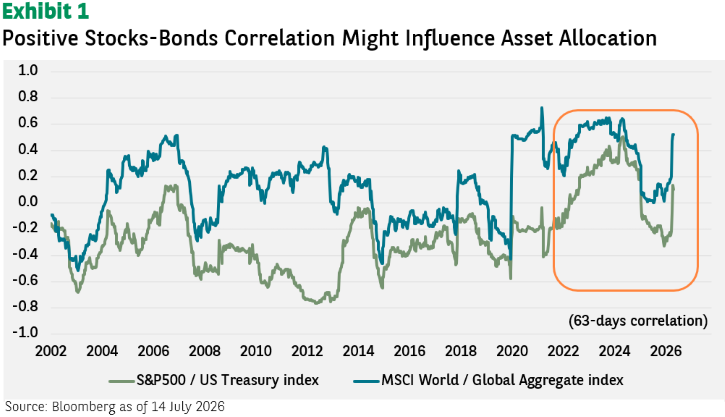
The behaviour of bonds and stocks has evolved since the pandemic. These key asset classes are now moving in the same direction much more often than was the case in the previous 20 years. This positive correlation might be a result of markets being more focused on inflation within a context of growing public debt ratios and solid corporate balance sheet fundamentals. It may also mean that traditional diversification is no longer a natural feature of balanced portfolios. Therefore, investors may potentially seek to shift towards a more active investment approach that respects the changing risk characteristics of blending bonds with stocks.
Words of wisdom:
Critical minerals: Critical minerals are resources a country considers vital for its economy and development. They experience high demand and are vulnerable to supply chain weakness, though what qualifies varies by nation. Critical minerals such as lithium and nickel have become increasingly important, particularly for technology advancements and defence systems. China is the leading processor of critical minerals, and many economies are seeking to reduce their dependence on it. Globally, public finance commitments to expand and diversify supply more than quadrupled to $65 billion between 2023 and 2025, according to a report from the International Energy Agency.
What’s coming up?
On Monday, Canada releases its latest inflation data. Tuesday sees the UK update markets with unemployment numbers and follows with its inflation report for June on Wednesday. On Thursday, the European Central Bank convenes for its monetary policy meeting; last month the ECB increased its key deposit facility rate by 25 basis points to 2.25%, its first rise in three years. Japan issues its own inflation update on Friday, when several Purchasing Managers’ Indices including those covering the eurozone, UK, US and Japan are issued.
[1] Source: FactSet, US dollar terms. Data as of 16 July 2026.


