
By Daniel Morris, Chief Market Strategist
With about half the companies in the S&P 500 having reported second quarter earnings, this season can justifiably be characterised as a ‘blowout’. Earnings for the S&P 500 are up 26% versus the same quarter a year ago. Not surprisingly, tech-oriented indices have seen even bigger gains thanks to massive artificial intelligence-linked capital expenditure. Profits for the Nasdaq 100 index have gone up nearly twice as much as for the S&P 500. The standout, however, is emerging market technology shares, where profits have more than doubled (see Exhibit 1).
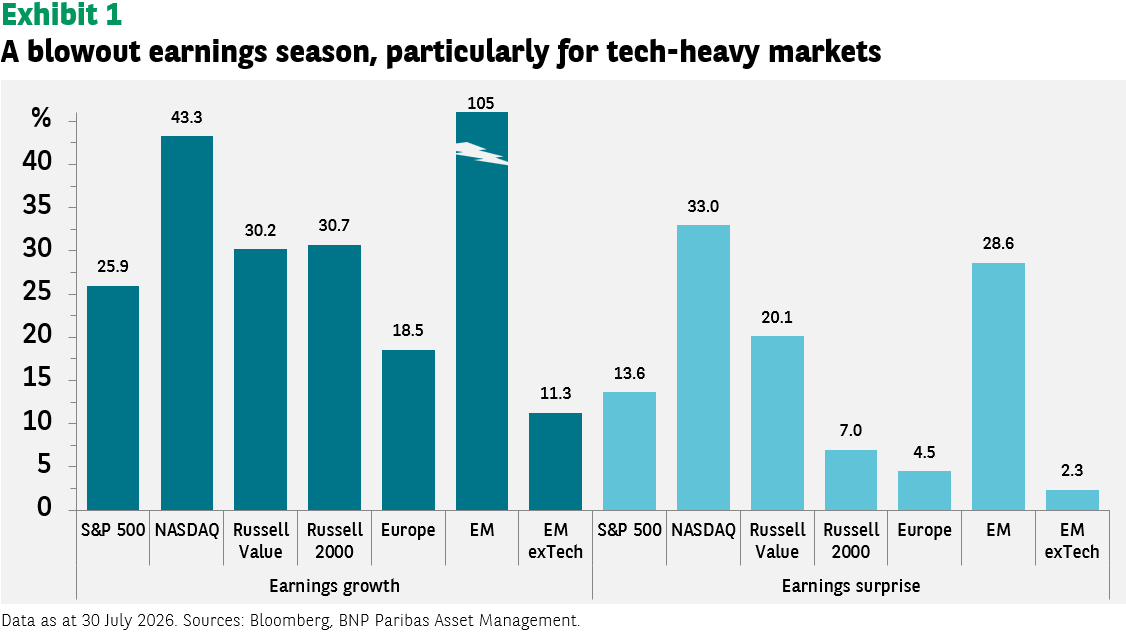
What’s more, these earnings have surpassed expectations (in aggregate). Typically, companies beat consensus estimates by 3%-4% each quarter. This quarter, the surprise percentage has ranged from 5% to over 30%.
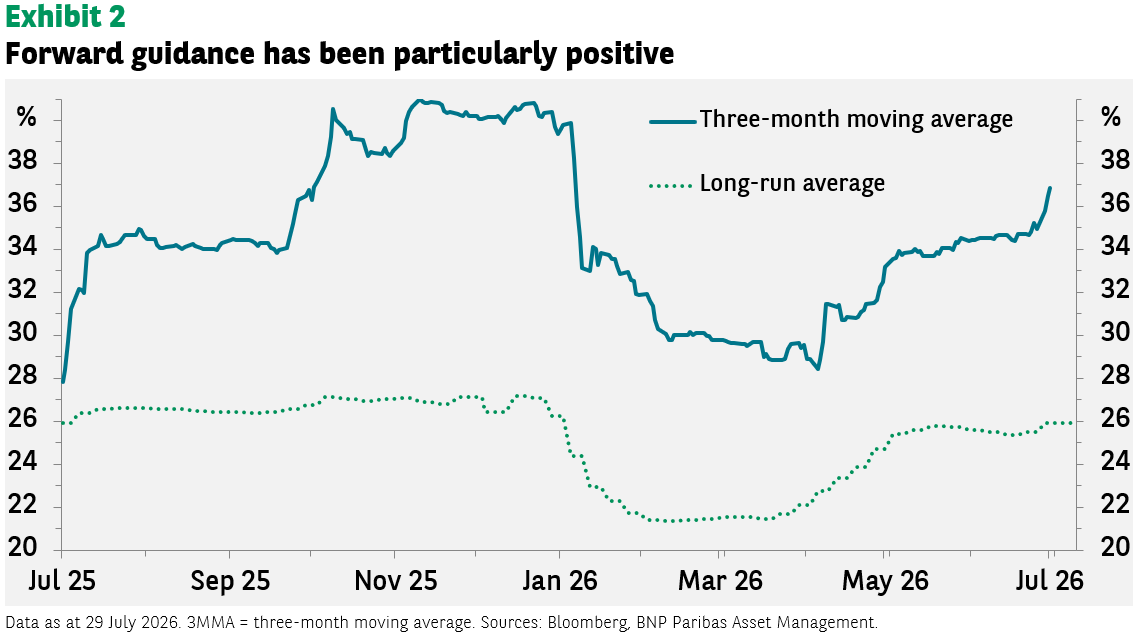
A final indicator of how well the season is going is the proportion of companies giving positive forward guidance, which is high and rising. This figure has been above the long-run average for a year, but it has improved further over the last few weeks (see Exhibit 2).
Market reaction
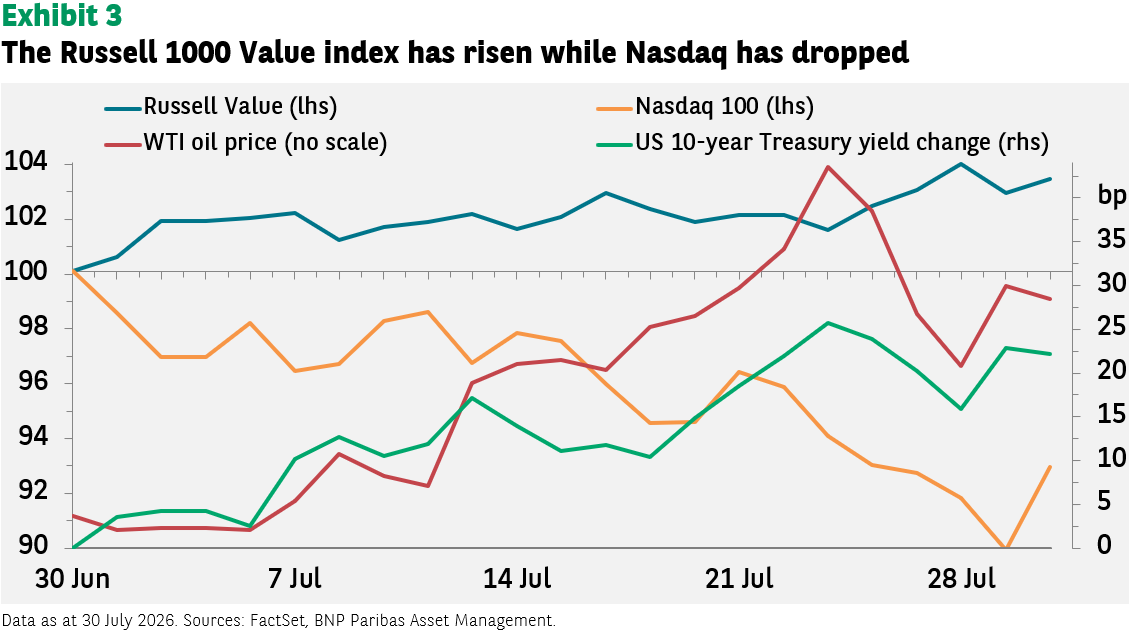
One might expect, then, that equity markets would be rallying on the news. Instead, many major indices have seen negative returns since the end of June.
There are several factors behind the declines, some of which may prove transitory. One key negative factor has been the rise in oil prices, currently up around 20% in July, as investors fear the renewed escalation of the conflict in the Middle East. Government bond yields have moved in lockstep with oil, with the impact of inflation on yields outweighing the consequences for growth.
The recent Federal Reserve meeting has added another layer of complexity. The Fed decided not to raise rates, and the press conference has been broadly interpreted as dovish. Observers noted the Fed’s commitment to controlling inflation but are less clear on what measures the central bank intends to use to achieve the objective.
Following the press conference, two-year Treasury yields declined as expectations for a near-term hike in the fed funds rate waned. Longer-term bond yields rose along with oil prices, but they rose more in the US than in Germany, perhaps reflecting worries about the outlook for inflation, and increasing term premia due to limited communications from the Fed.
Meanwhile, emerging market tech stocks have seen a major correction, with Korean hardware and semiconductor stocks falling 47% from their June peak to the trough (as at 30 July 2026), though there has been a sharp rebound since. This drop has spilled over to Taiwanese and US tech indices. Some perspective is necessary, however; the sell-off still leaves Korean tech stocks 79% higher, and Taiwanese stocks 49% higher, than they were at the beginning of the year.
Other markets have proved more resilient. The MSCI Europe index is in positive territory, and the Russell 1000 Value index has moved up over 3% this month, propelled by positive earnings (see Exhibit 3).
The strong earnings results for tech stocks suggest that recent market declines in emerging markets are more a function of stretched positioning and a recalibration of the earnings outlook than a fundamental reassessment of corporate profits. With valuations now far more attractive, and earnings still forecast to rise significantly in the quarters ahead, we believe there is potential for a sustained recovery at some point.
Non-tech markets, meanwhile, have generally been moving steadily higher, supported particularly in the US by AI-spending spillovers and resilient consumer demand. We do not foresee a weakening in those pillars in the near term.
Data sources: Bloomberg, FactSet, BNP Paribas Asset Management as of 30 July 2026 (unless otherwise stated). Past performance should not be seen as a guide to future returns.


