
By Daniel Morris, Chief Market Strategist
As the third quarter earnings season kicks off, investors are nervous given the recent sharp rise in bond yields, which have so far had only a modest impact on equities. While the MOVE index, which measures expected bond market volatility, has returned to levels last seen with the start of the Iran war, the VIX index of equity volatility is not far from the lows for the year.
The dominance of technology hardware in driving earnings growth and equity price appreciation means that any disappointing announcements from these companies will likely be keenly felt. Expectations are high, with the sector globally forecast to see a doubling of earnings compared to the same quarter a year ago. For emerging markets, it is twice that.
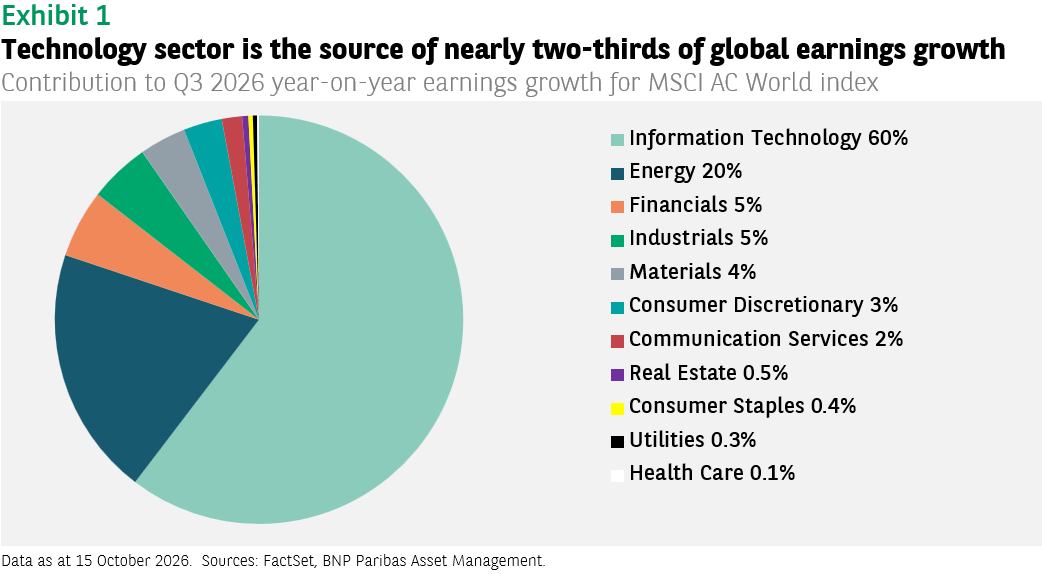
These growth rates are substantially higher than those for other sectors, leading some to see the concentration of earnings growth this quarter as a sign of the market’s fragility. It is true that tech earnings will likely dominate the season. They account for nearly two-thirds of the increase in profits for equities globally, followed by energy stocks at 20% (see Exhibit 1).
The dominance of tech earnings, however, is not inherently bad if the other sectors are themselves generating sufficiently positive growth in profits, even if the absolute increase in profits is far less than for technology. For this quarter, however, that is only partly the case.
The median earnings growth for the remaining sectors (that is, excluding tech and energy) is 7%, which is not particularly high. The materials sector is the one expected to see the strongest growth, but most of the forecasts for the other sectors are comparatively low (see Exhibit 2). If this pattern were to continue into the quarters ahead, one would indeed expect the market to be vulnerable as technology would be practically the sole source of profit expansion.
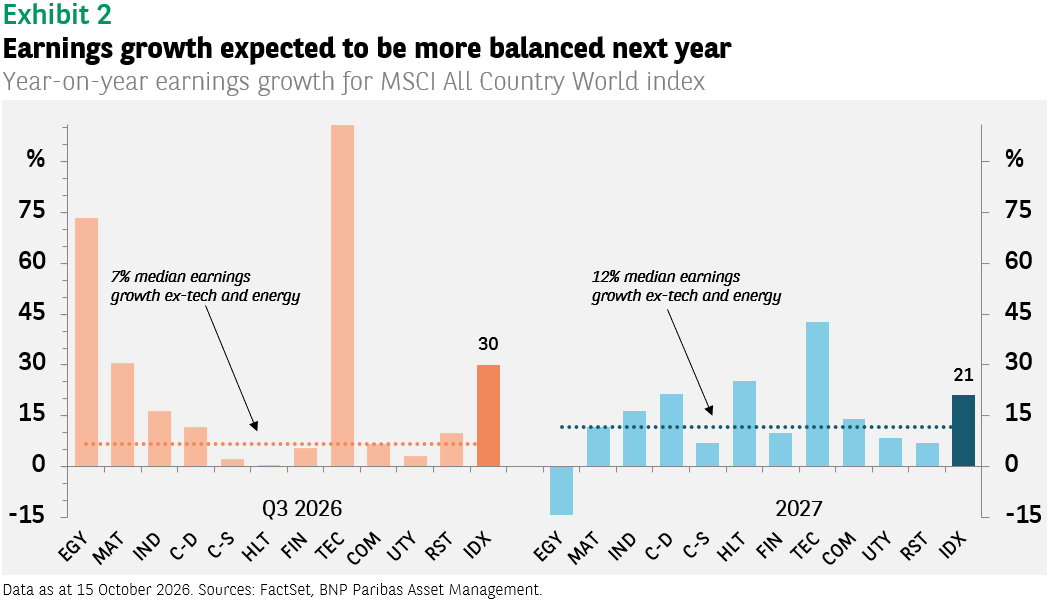
For 2027, however, the pattern is forecast to be different. Earnings growth for the energy sector turns negative, while it moderates for the tech sector. The growth rate for the remaining sectors rises to 12%, spread more evenly across the sectors. That should be sufficient to support ongoing market appreciation.
Third quarter forecasts
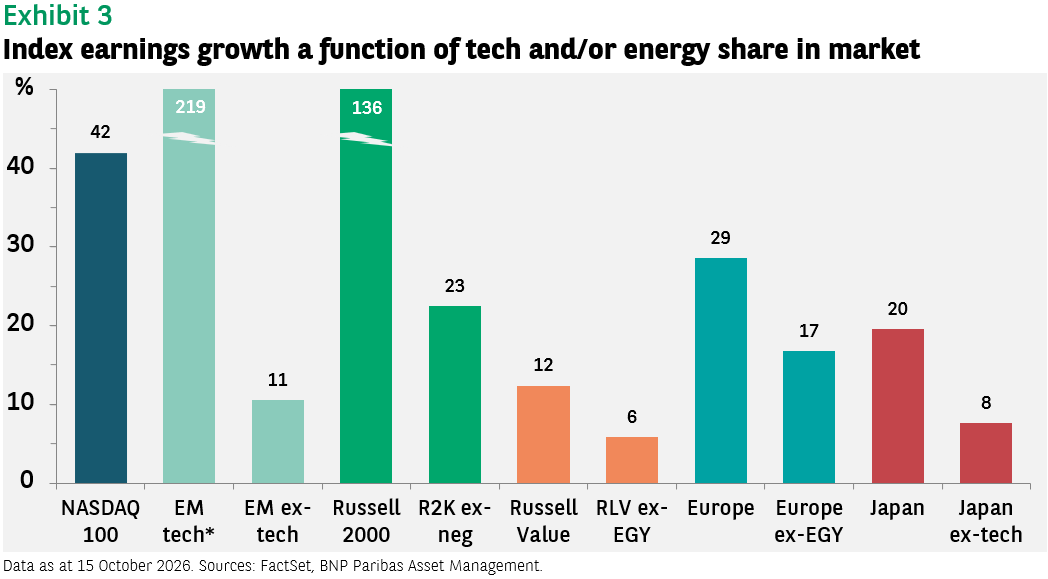
The importance of the tech and energy sectors for earnings is reflected in the third quarter forecasts for country and regional indices. Growth rates for indices with a large share of tech or energy stocks are high, while excluding these sectors results in lower figures. For example, we noted that emerging market tech stocks earnings are expected to increase more than four-fold, but for the remaining sectors the forecast is just 11%. In Europe, the 29% gain expected for the index this quarter is reliant on the energy sector; if we exclude it, the growth rate drops to 17% (which is still good; see exhibit 3).
EM tech volatility
Despite the renewed increase in oil prices over the last week, and the higher-than-expected US CPI (consumer price index) inflation data, Treasury yields have dropped by more than 20 basis points from their recent peak. This has prompted a modest rebound in non-tech equities globally. The tech hardware sector, however, has seen another wave of selling, concentrated in South Korea, as it was last July.
We have always expected above-average volatility in the tech sector because of the newness and significance of the artificial intelligence phenomenon. Price gains have been so large, and earnings expectations so high, that any marginal change in sentiment has a commensurately bigger impact.
We remain positive on the medium-term outlook and see volatility along a rising trend. Nonetheless, the impact of AI investment should continue to broaden to other sectors, notably in the US, allowing for the wider breadth of earnings, as shown in Exhibit 2.


