
By Daniel Morris, Chief Market Strategist
High-yield credit markets are often seen as ‘the canary in the coal mine’ when it comes to economic activity. Highly levered companies often feel the pain of a slowing economy sooner than others, and worries about profitability are then seen in the spreads of corporate high-yield bonds over Treasuries.
Over the last month, US high-yield option-adjusted spreads have jumped suddenly and significantly, from 267 basis points on 8 September to a peak of 318 basis points on 1 October. This level is not far from the peak reached at the end of March, when high oil prices raised fears of an energy-shock-induced slowdown in the US and Europe (see Exhibit 1).
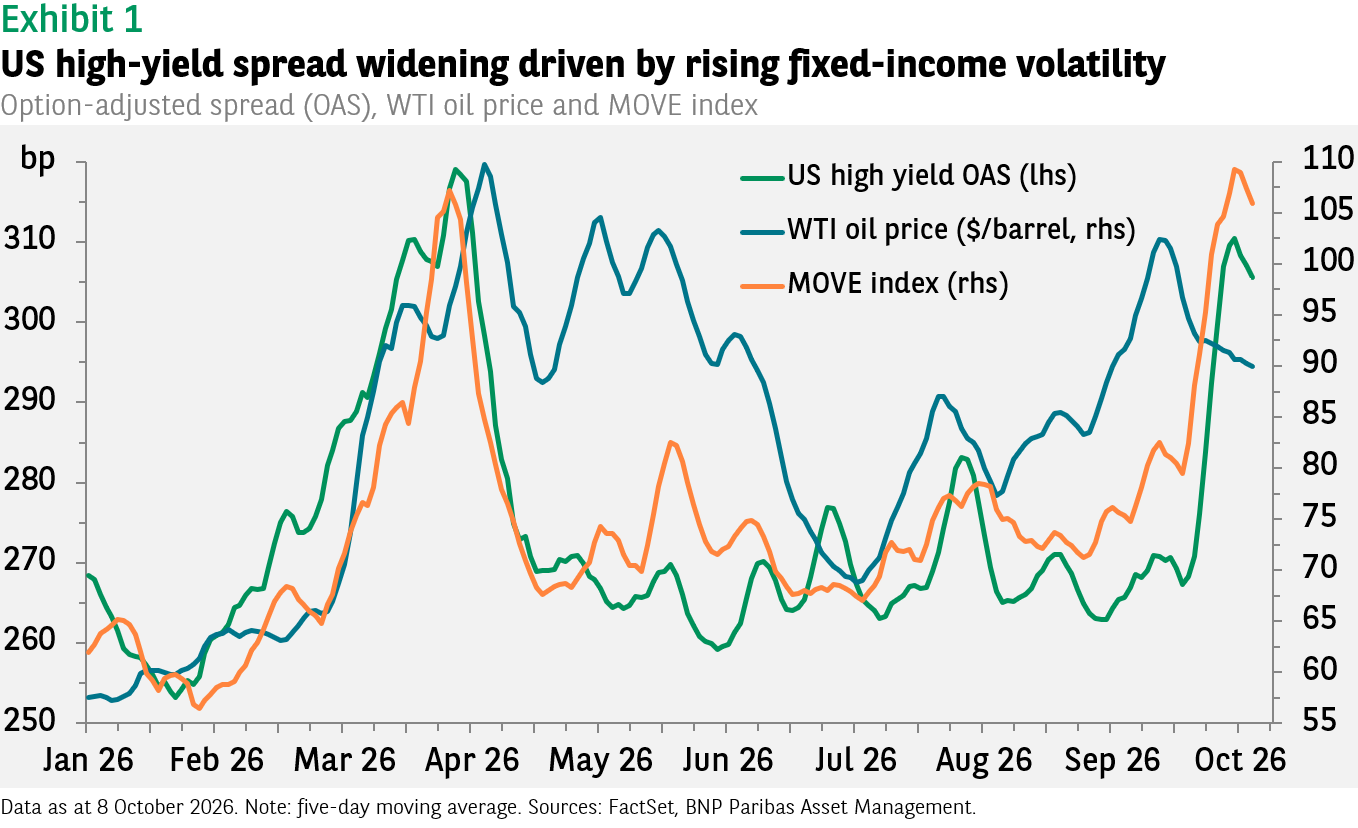
The pattern of higher oil prices leading to wider spreads initially repeated itself following the jump in oil prices that began in July. But then the correlation broke down: oil prices continued to rise to near their peak April levels, but high-yield spreads fell back. Subsequently, oil prices fell but spreads rose.
One reason spreads may have retreated in August is because of the lessons learned from the oil spike in April, when economic slowdown worries proved unfounded. In fact, economic data has come in better than expected.
The most recent surge in spreads has been driven primarily by the jump in fixed-income volatility, as measured by the MOVE index. Strong US economic data has raised concerns about an overheating economy and the prospect for further policy rate hikes from the US Federal Reserve. In France, the upcoming elections and the country’s precarious fiscal situation have spilled over to government bond yields globally.
Another contributor to wider spreads has been the supply/demand imbalance. Heavy issuance by hyperscalers has driven up investment-grade yields as their highly-rated offerings put pressure on government bond yields. Within high yield, September was the fifth busiest month ever for gross and net issuance. At the same time, the jump in interest-rate volatility put off debt buyers: two weeks in the month saw net outflows.
A large part of the index spread widening has been concentrated in a few names in the lower-ranked parts of the index (CCC), with spreads for higher-rated names being dragged along. Our portfolio managers see the rise in yields across the ratings spectrum as creating opportunities among BBB rated names. If interest-rate volatility declines, the current yield on the high-yield index looks attractive.
Economic fundamentals
The idea that the increase in high-yield spreads is an indicator of economic stress is hard to square with the data coming from the US. Recent non-farm payrolls figures did show a deceleration in job creation and negative revisions for prior months, but this release was the exception. Moreover, the data may not be as weak as it first appears.
One challenge in interpreting each month’s payrolls release has been the frequent revisions and occasionally odd seasonal adjustment factors, which have added to the volatility in the monthly data.
For example, September’s low headline private payrolls growth figure of just 46,000 jobs was due to a large decline in the Administrative & Support Services segment. This could indeed be a sign of a slowing economy as one of the first things companies often do to reduce costs is to lay off temporary workers. The drop, however, is the largest in a year and does not align with other anecdotal evidence of a solid labour market. The adult unemployment rate was steady at 3.8%.
An alternative way to get a sense of the underlying trend in employment, avoiding the complications introduced by seasonal adjustment factors, is to look at the year-on-year change in the non-seasonally adjusted data. By this measure, employment growth actually improved slightly in September to 0.5% (see Exhibit 2).
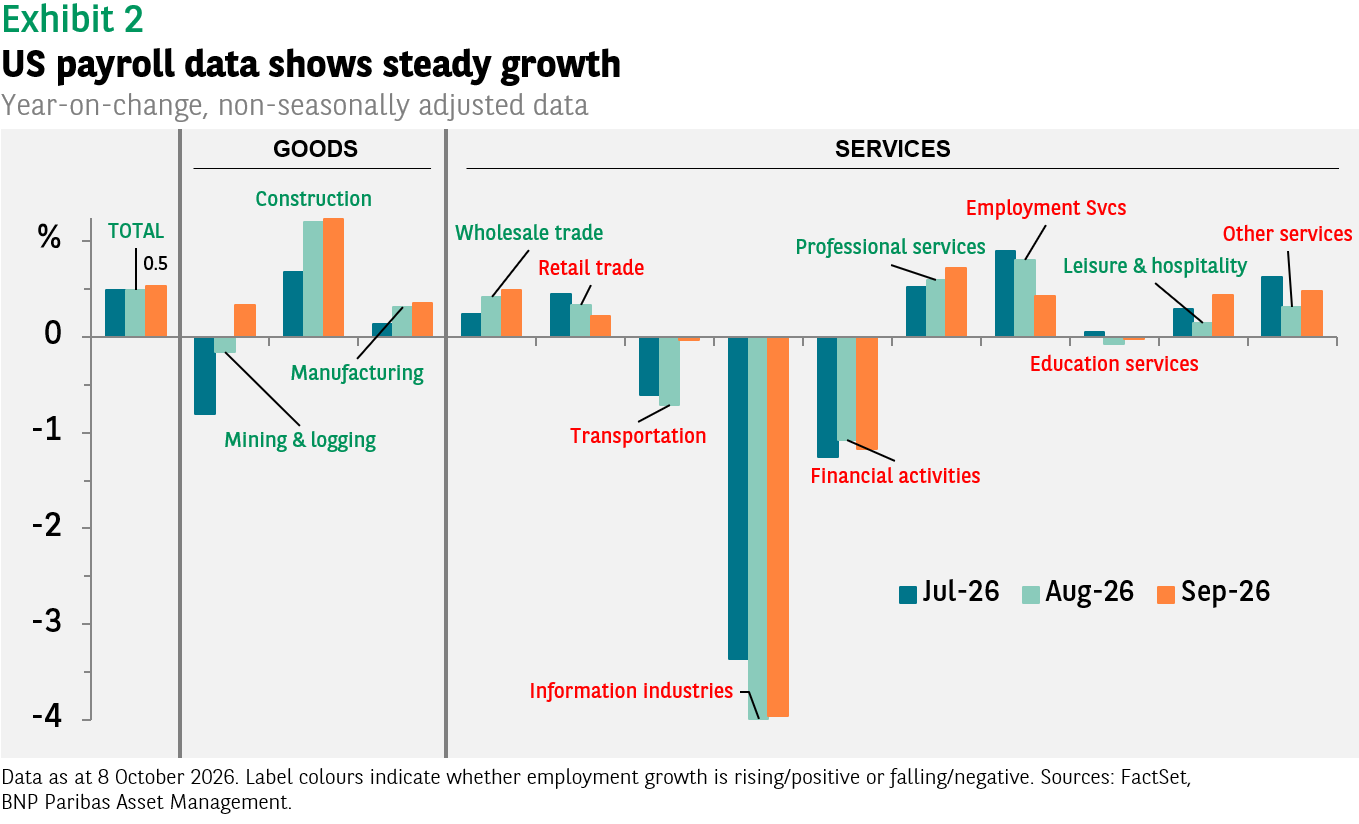
The positive impact of artificial intelligence investment can perhaps be seen in the improving growth rates for goods industries (mining, construction and manufacturing), and the destructive impact in the negative growth rates for the information industries and financial activities. The youth unemployment rate, another area where one might anticipate AI reducing demand for entry level workers, jumped from 7.1% to 8.0%.
Outlook
Economic growth momentum in the US is supporting corporate profits and fundamentals have improved. Our fixed-income team is overweight US high yield, but investors must still remain vigilant as higher official rates may put pressure on some sectors.


