
What do you need to know?
Stocks reached new highs once again last week on the back of strong corporate earnings announcements and optimism over a potential deal to reopen the Strait of Hormuz. The S&P 500, Dow Jones Industrial Average and European Stoxx 600 indices all hit fresh highs, ending the week to Thursday’s close up 4%, 3% and 2% respectively. Meanwhile Japan’s Nikkei gained 7% and the MSCI World NR Index rose 3% over the period.*
*In US dollar terms. Source: FactSet, data as of 6 August 2026
Around the world
Eurozone business activity reached an eight-month high in July, returning to growth for the first time since March. The composite Purchasing Managers’ Index, which includes both manufacturing and services, increased to 52.0 from 50.0 in June – a reading above 50 indicates expansion. Elsewhere, the US composite PMI rose to 54.5 from 51.9 in June, the strongest since October 2025 while China’s fell to 50.8 from 53.6, reflecting softer gains in both manufacturing and services.
Figure in focus: $1.1 trillion
The market for key clean energy technologies – including solar, wind, batteries, electric vehicles, heat pumps, and electrolysers – exceeded $1.1 trillion in 2025, according to the International Energy Agency. After average annual growth of around 20% over the past decade, their market value is projected to reach $1.9 trillion by 2035 – roughly equivalent to the size of the global crude oil market in 2025. If government policy intentions are included, it could reach more than $2.6 trillion by 2035, the IEA said.
Chart of the week
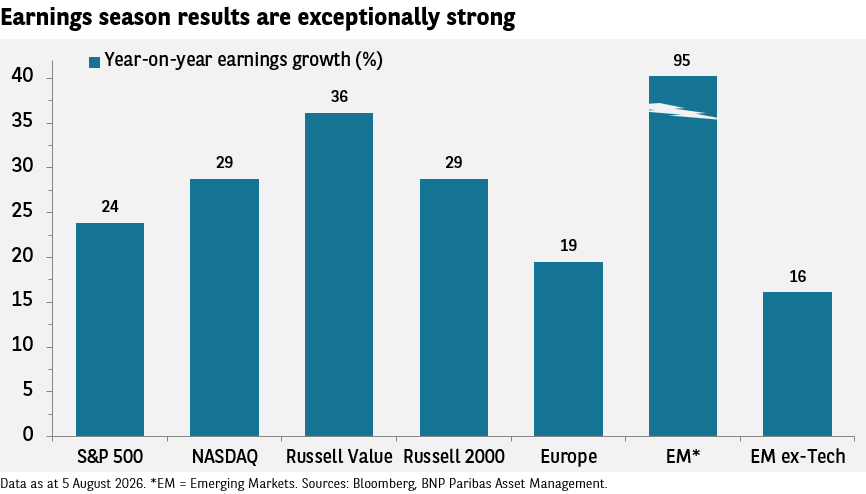
If equities are all about “earnings, earnings, earnings”, then markets should be in a pretty good mood. The majority of companies have now reported their earnings for the second quarter, and the results have been exceptionally strong. Not surprisingly, profit growth for tech-heavy indices has been very good; earnings from emerging market tech companies have more than doubled. But thanks to high oil prices and good results for banks, value-oriented indices have also seen double-digit earnings growth. What is even more impressive is that these figures are significantly better than what was expected.
Words of wisdom: AI Act
The European Parliament’s legal framework around artificial intelligence, including rules on biometric identification, chatbots and cybersecurity came into effect at the beginning of this month. Passed in 2024, the AI Act aims to ensure systems are safe and ethical for European citizens, while positioning Europe as a leading regulator and innovator in the new technology. Under the new rules, systems must now disclose when a person is dealing with a machine and artificially generated content must be labelled.
What’s coming up?
On Monday, the Bank of Japan publishes its Summary of Opinions following its July monetary policy meeting. Tuesday sees the Reserve Bank of Australia meet to decide interest rates and on Wednesday the US updates markets with its latest inflation data. On Thursday, the UK issues a preliminary estimate for Q2 GDP growth, and the eurozone follows with a second estimate for Q2 growth on Friday.


