
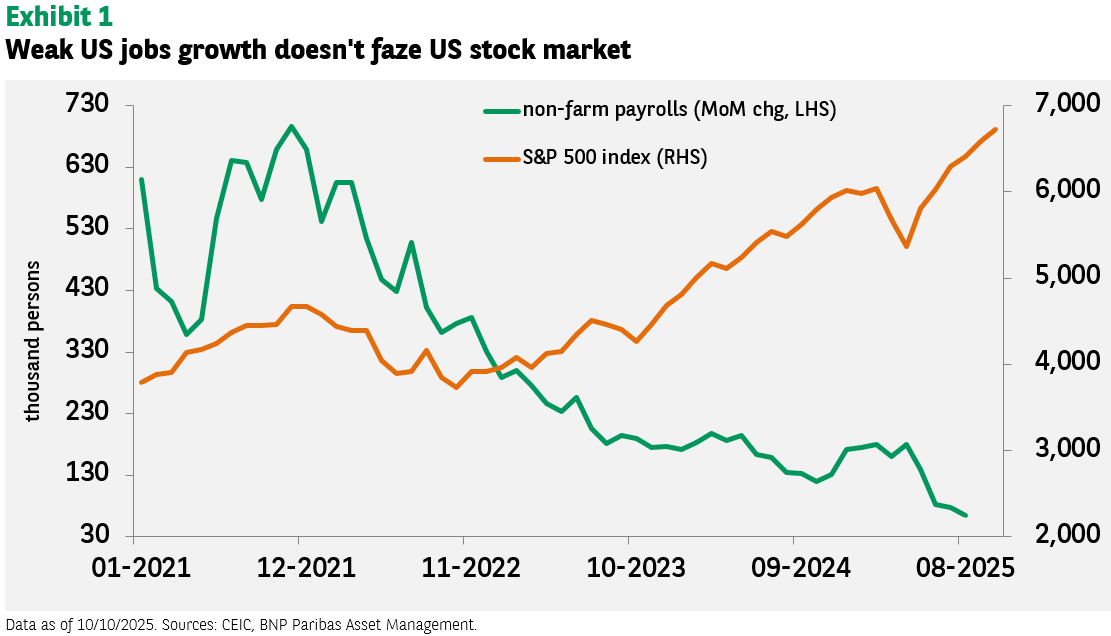
The US labour market has weakened: the six-month moving average of non-farm payroll job gains was less than 64,000 in August (the latest data available due to the US government’s shutdown). This compares to the 696,000 average marking the most recent cyclical peak in late 2021. This weakness has not hindered the advance of the S&P 500 equity index. Why not?
Firstly, a very significant surge in artificial intelligence (AI), tech-related investment is helping to ease financial conditions and creating wealth gains for US consumers. The expectation is that AI will continue to boost labour productivity and corporate profits.
Secondly, market expectations of forthcoming interest rate cuts by the Federal Reserve have reduced risk aversion, prompting investors to deploy cash to get higher returns from risk assets such as stocks.
This week, the International Monetary Fund forecast the US economy would expand by 2% this year and 2.1% in 2026. That marks a slowdown from 2.8% in 2024, but it is by far the strongest growth rate for any of the G7 leading economies and a slight upgrade from July’s IMF forecast. In April, the fund had said US growth would even slow to 1.8% this year.


