
Former US Federal Reserve Chair, Ben Bernanke, once quipped that “monetary policy is 98% talk and 2% action”. But recently, central banks have tried to shift more towards action, primarily through strategy reviews – focusing on the modelling framework and repeated references to the incoming data landscape.
Still, semantic nuances and almost imperceptible variations in tone make fascinating fare for watchers and investors alike.
We’ve lived through many shocks and surprises this year, but the economy has remained resilient thanks to a technological innovation – namely artificial intelligence – that promises to affect our productivity beyond the scale experienced in the mid-1990s.
At the same time, inflation has surprised to the upside. These two variables merit our attention.
Measuring the AI effect
There is a tremendous effort to measure AI’s contribution to output and economists will undoubtedly receive more information as the technology spreads to all sectors of the economy.
The adoption process takes some time – in 1987 Nobel Prize winning economist Robert Solow famously said “you can see the computer age everywhere but in the productivity statistics” – but we can rely on a solid theoretical framework which allows us to put technological change, potential growth and the natural rate of interest into one box.
And that is exactly what central bankers have done in the past 12 months, as they’ve realised that monetary policy’s neutral range might have shifted upward owing to an unprecedented productivity boost.
Neutral rate – where art thou?
Of course, if you ask two central bankers where they see the neutral interest rate – the theoretical real interest rate which neither stimulates nor restricts growth – you will most likely hear three different answers. This is where the art of central banking is required, and where the wording and the nuances matter most.
In retrospect, we could say that both the Fed and the European Central Bank have done a tremendous job in not scaring the financial markets, by describing their actions as a step-by-step search for the neutral interest rate. In doing so, they have smartly avoided the risk of sparking a painful discussion about a tightening cycle.
Market-based expectations at the beginning of 2026 were for two rate cuts by the Fed and the ECB standing pat. Instead, the Fed has already hiked once and is expected to deliver another 25 basis points in December. Similarly, the ECB has already increased rates twice and will most likely add a third hike in a few weeks’ time.
This is a significant U-turn in monetary policy, which under normal circumstances might have triggered fears of a recession. Not in 2026, though, and the reason might again be technological change and central banks’ wise guidance on the neutral interest rate.
The next chapter: Inflation
I think we are within reach of the neutral rate, both in Frankfurt and in the US. The question is therefore about the next chapter in this monetary policy story, which leads us straight to inflation.
Since the Middle East crisis, inflation has accelerated almost everywhere due to both direct and indirect effects. On the other hand, there is little evidence – indeed, arguably none – of so-called second-round inflation, which is primarily associated with inflation expectations and requires an asymmetric inflationary shock to be both deep and long-lasting.
Therefore, central banks are managing the risk of second-round inflation rather than inflation itself, as recently suggested by Bank of England Chief Economist, Huw Pill.
Looking ahead, the risk is that the current above-target inflation mutates into entrenched inflation. Growing inflation expectations should be on everybody’s radar screen as this would constitute another significant surprise for market participants after this year’s policy U-turn.
Concretely, the risk is about central banks having to switch from their storyline of “reaching neutral” to one of a “policy tightening cycle”, thus hitting both risk premia and corporate valuations.
As Exhibit 1 shows, the market is not pricing in a hiking cycle for the Fed or the ECB beyond the next two to three rate hikes. In other words, a policy path that diverges significantly from whatever neutral level the central bankers have in mind would definitely take investors by surprise.
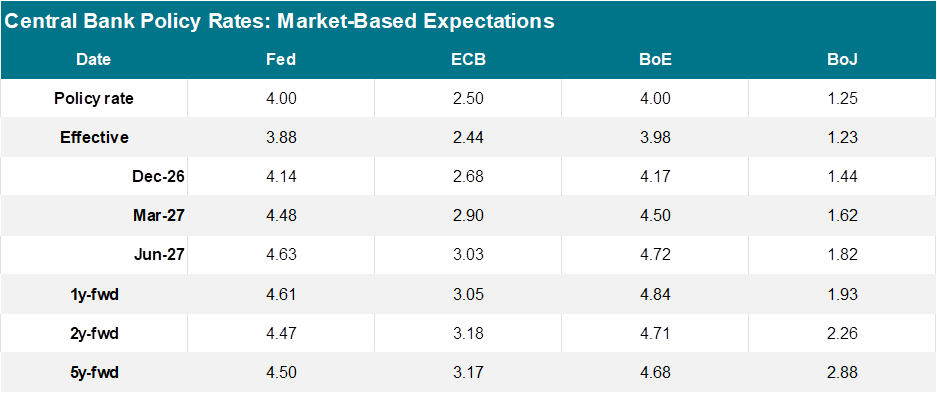
Source: Bloomberg, 18 November 2026
Government bond markets: More than just inflation and rates
Equally, the bond universe is not immune to such a scenario. Market-based inflation expectations have orbited slightly above target for the past four years, thus confirming both central banks’ credibility and a striking contrast with survey-based inflation measures.
However, the discussion about government bond markets is more subtle than just inflation and interest rate expectations.
According to the International Monetary Fund’s Fiscal Monitor, expansionary fiscal policy in an environment of increasing yields will require ever-increasing bond issuance by governments in developed markets for the next five years.
And as the demand side can no longer rely on infinitely elastic balance sheets (i.e., quantitative easing), the question suddenly becomes: Who will buy all these bonds, and at what price?
If there is one certainty in a world of uncertainty, it is that there will be more government bonds tomorrow than there are today.


