
What do you need to know?
Stocks fell sharply last week following the results of the US midterm elections as concerns escalated over whether there would be a slowdown in artificial intelligence development. The S&P 500 index dropped by 5% while the tech-heavy Nasdaq declined 7% in the week to Thursday’s close*. Japan’s Nikkei fell 6% while Europe’s Stoxx 600 index gained 1%. US stocks initially rallied after the Democrats won control of Congress in the midterm elections, but unease subsequently grew over potentially tighter controls on data centres, and if restrictions could be put on AI advancement.
*In US dollar terms. Source: FactSet, data as of 5 November 2026
Around the world
The Bank of England raised UK interest rates by 25 basis points to 4%, its first hike in more than three years. Eight of the nine policymakers voted for this increase, while one opted for a 50bp hike. The central bank said the increase was due to the “degree of inflationary pressure in the pipeline”. BoE Governor Andrew Bailey warned that unless the Middle East conflict is resolved, the rate hike was not likely “to be the last”. Elsewhere, the Reserve Bank of Australia raised interest rates by 25bp to 4.85%, the fifth hike this year, and the highest level since 2008.
Figure in focus: 4.0%
Eurozone annual inflation rose to a three-year high in October, as the Middle East conflict continued to push up energy prices. Inflation rose to 4.0% from 3.8% in September, an official flash estimate showed, driven by a near-21% surge in the energy component. Excluding energy, food, alcohol and tobacco, core inflation remained steady at 2.5%. The data added to expectations that the European Central Bank will raise interest rates at its next meeting in December.
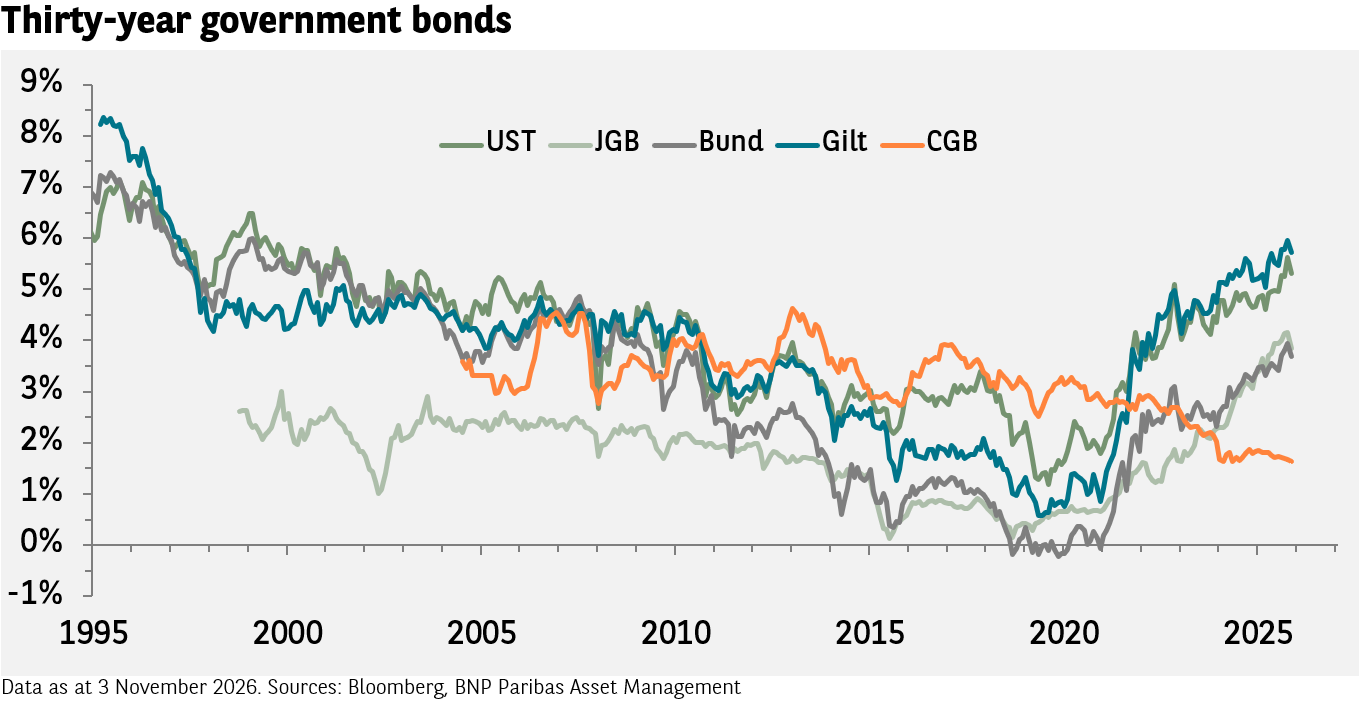
Chart of the week
Long-dated bond yields have been on the rise for the past six years, translating to higher borrowing costs for governments and companies. For example, 30-year German government bond yields have increased by almost 400bp after hitting all-time lows during the pandemic. This upward direction is shared across all major advanced economies, with the exception of China. Both cyclical factors – higher than expected inflation and monetary policy tightening – and structural factors like persistent public deficits have contributed to this rise in long-dated yields.
Words of wisdom: Cryosphere
The cryosphere – the parts of the Earth’s surface that are covered by water in a solid state, including ice and snow – faces permanent damage if the Paris Agreement’s 1.5°C climate change target is exceeded. Overshooting this goal will bring “large-scale, and in many cases irreversible,” impacts, such as rising sea levels and water shortages as glaciers disappear, according to a new report from the United Nations. It called for increased emissions reductions as well as more financing for climate change adaptation.
What’s coming up?
On Monday, China publishes its latest inflation rate, followed by trade data on Tuesday. Tuesday also sees the US report inflation data for October – US inflation rose more than expected to 3.7% in September. On Thursday, the UK issues a preliminary estimate of its third quarter GDP growth rate. On Friday, the eurozone publishes a second estimate of its own Q3 GDP growth rate.


