
What do you need to know?
US interest rates will likely need to rise further to rein in inflation, the minutes of the Federal Reserve’s last meeting indicated. The Fed kept rates on hold in October, but two of the 12 policymakers had favoured a 25-basis-point rate hike, and “almost all participants” thought that tighter monetary policy would be appropriate in the coming months. Several governors maintained that the direction of interest rates is of greater significance than individual moves. Meanwhile, US retail sales increased at a slower pace in October than the month before, as higher petrol prices put consumers under pressure.
Around the world
Japan’s economy unexpectedly shrank 0.1% in the third quarter of this year, on an annualised basis, a sharp reversal from Q2’s 1.7% expansion. Analysts had expected growth of 0.1%. Elsewhere, the eurozone economy is expected to grow by 1.2% this year and next, rising to 1.3% in 2028, according to the European Commission. It had previously forecast growth of 0.9% for 2026 and 1.2% for 2027. Better-than-expected growth has been driven by steady consumption and a sharp rebound in exports, it said. Separately, eurozone annual inflation was confirmed at 4.0% in October – a three-year high – and up from September’s 3.8%.
Figure in focus: $1.5 trillion
The technology sector was in focus last week as artificial intelligence company Anthropic made its stock market debut with a record initial public offering where it was valued at $1.5 trillion. Listing on the US Nasdaq index, the Claude creator beat SpaceX’s previous IPO record. However, investor enthusiasm around the listing was not enough to lift tech stocks over the week and they continued to endure volatility amid concerns over the level of AI capital expenditure. The Nasdaq fell 6% in the week to Thursday’s close, though year to date the tech-heavy index is up 3%.* The broader S&P 500 index fell 5% last week but is up 6% over the year.
*In US dollar terms, source: FactSet, data as of 19 November 2026
Chart of the week
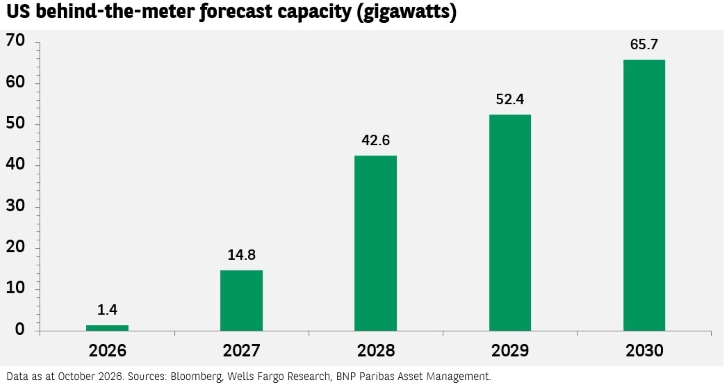
Power availability remains one of the most critical constraints on data centre capacity growth. Surging AI-driven demand, coupled with grid interconnection delays, is incentivising hyperscalers and industrial players to shift toward on-site power generation. Developers are increasingly flexible, operating outside of the national grid to ease bottlenecks. Such ‘behind-the-meter’ energy sources are projected to grow 47-fold by 2030, representing one of the most significant structural shifts in decades. Natural gas turbines currently dominate the fuel mix, while renewables and new nuclear energy are emerging as key alternatives.
Words of wisdom: Global Stocktake
The second Global Stocktake began at the United Nations climate change conference COP31 last week and will conclude in 2028. Countries will assess their progress towards meeting the goals of the 2015 Paris climate agreement, including limiting global warming to 1.5°C. “Geopolitical headwinds are fierce. But an ambitious outcome is within reach,” UN Climate Change Executive Secretary Simon Stiellsaid at the launch event. The first Global Stocktake, from 2021 to 2023, also saw countries agree to triple global renewable energy capacity by 2030 and transition away from fossil fuels.
What’s coming up?
On Monday, flash Purchasing Managers’ Indices – indicating manufacturing and services activity – are issued for the eurozone, UK and US, followed by Japan on Tuesday. On Wednesday, the US reports a second estimate of Q3 GDP growth. On Thursday the European Central Bank publishes the minutes of its latest monetary policy meeting; in October, it opted to keep interest rates unchanged.


