
What do you need to know?
The US Federal Reserve unanimously voted to raise interest rates by 25 basis points to 3.75%-4.0%, marking the first hike since July 2023. Fed Chair Kevin Warsh highlighted that “inflation is too high and has been for too long” and the central bank’s official projections showed most policymakers expect another rate increase before year end. Ahead of the Fed’s decision, bond yields rose on inflation concerns while tech stocks suffered after artificial intelligence leaders called for a slowdown in development.
Around the world
The Bank of Japan raised its benchmark interest rate by 25bp to 1.25%, a 31-year high. It said the decision reflected the risk that inflation could move beyond the bank’s 2% target – annual inflation held steady at 1.9% in August. Meanwhile the Bank of England kept interest rates on hold at 3.75%, though warned that rates may have to increase if high energy costs persist; UK annual inflation rose to 3.1% in August from 2.9% in July, a five-month high. Elsewhere, Eurozone annual inflation was confirmed at 3.2% in August, from 2.9% in July.
Figure in focus: 58%
More than half of US consumer spending, at 58%, is now taking place online, driven by convenience and affordability, new research has found. That compares to 48% in 2019, according to payments firm Visa. Consumers are also shopping online more frequently, with 25% of US payment cards being used for 10 or more transactions per month, up from 13% in 2018. This growing trend, which it calls the ‘couch economy’, highlights how technological advancements have improved accessibility to products and services, and how digital platforms are increasingly being used to manage everyday activities.
Chart of the week
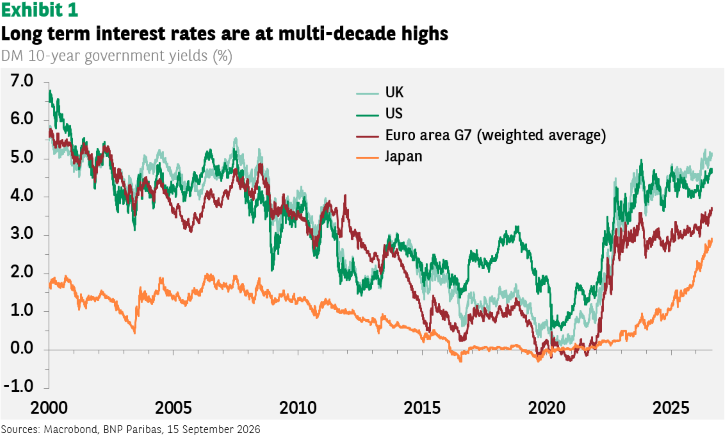
Global bond yields continue to rise. The US 10-year yield climbed above 5% last week for the first time since July 2007, while Japan’s benchmark 10-year bonds saw their highest yield in 30 years, at around 3.04%. Germany’s 10-year Bund yields surpassed 3.5%, a level not seen since June 2009. This bond market weakness is the latest stage in a long normalisation after the historic anomaly of ultra-low yields in the 2010s. The good news is that bond yields are now reaching levels that will provide income. As this compounds over time, it should help cushion volatility and potentially reward long-term investors.
Words of wisdom: Northern Metropolis
Hong Kong’s vast infrastructure initiative, Northern Metropolis, hopes to boost economic growth and transform part of its countryside into an industrial and technological powerhouse. The plan aims to renovate 30,000 hectares of land – one third of Hong Kong’s land mass – into four economic hubs, to provide 650,000 jobs and house 2.5 million people, with the hope of easing its long-standing housing crisis. The scheme was first unveiled in 2021 and will now form a key part of Hong Kong’s first five-year economic growth plan which was unveiled last week.
What’s coming up?
Several flash estimates for September Purchasing Managers’ Indices are issued on Wednesday, including those covering the US, eurozone and UK. Japan follows with its own PMIs on Thursday, when Australia also reports its latest unemployment figures and Germany publishes its closely watched Ifo Business Climate Index – the measure rose to 88.8 in August, its highest level in a year.


