
- Emerging market equities have increasingly evolved into a technology and manufacturing-led asset class
- A massive shift of cash flows from US hyperscalers to Asian semiconductor and hardware manufacturers is creating a rich hunting ground for active stock selection
- The combination of strong earnings momentum, attractive valuations and improved macroeconomic resilience makes EM equities a potentially attractive opportunity
By Zhikai Chen, Head of Asia and Global Emerging Markets Equities
Traditionally, investors have viewed the investment case for emerging markets (EM) equities as predominantly based on favourable demographics, mining and low-cost manufacturing. We believe it is time for a thorough re-appraisal.
The current reality presents a striking contrast: EM equities has evolved into an asset class dominated by technology and advanced manufacturing.
Today, the combined weight of information technology and communication services stocks account for 44% of the MSCI Emerging Markets Index. Taiwan and South Korea, the two North Asian tech powerhouses, account for nearly half of the entire EM index.
In recent years, EM markets have decorrelated from the commodity cycles. EM equity performance is now driven mainly by earnings, anchored by frontier technology, hardware manufacturing and global infrastructure capital expenditure.
What makes this positioning distinctive is its ‘pick-and-shovel’ profile – these are the companies that supply the critical tools and services supporting such sectors. And they have become vital to global growth, driven by burgeoning investments in renewable energy, the migration from internal combustion engines to electric vehicles, and artificial intelligence.
Decades of manufacturing relocations mean most of the major microchip makers – from integrated circuit design houses to foundries and other key suppliers in these critical technologies – are now located in emerging markets.
These companies now occupy a sweet spot of being simultaneously crucial suppliers to the current global tech industry, while trading at a persistent valuation discount relative to developed market mega-cap tech companies.
The main issue that will confront global asset allocators is whether the traditional view of EM as a diversifier for global assets within portfolios still makes sense in a world where EM is pivotal to the world’s future growth drivers and capital expenditure (capex). Another question is whether these structural earnings growth engines can persist, broaden, and drive a durable market upswing.
The AI cash flow equation
Debate around the sustainability of global investment in artificial intelligence (AI) has intensified in recent months. Investors have increasingly questioned whether hyperscalers’ capex can remain at current levels, particularly as free cash flow – the cash remaining after a company has paid all its running costs and bought the equipment it needs to stay in business – comes under pressure, and the monetisation of AI capabilities while growing strongly is still small relative to the capex.
While US tech giants can absorb short-term setbacks that weigh on their free cash flow and navigate probing questions about return-on-invested-capital, Asian semiconductor, equipment and component manufacturers sit comfortably on the receiving end of this cash transfer. This dichotomy results in a stark divergence in cash flow trajectories.
The consensus estimate is that the top five US hyperscalers’ project capex will reach around $860 billion in 2026. Simultaneously, the aggregate free cash flow generation by just three of Asia’s memory and foundry titans is forecast to exceed $300 billion.1
This outpaces the aggregate free cash flow of the top US hyperscalers in 2025, before it dips into negative territory this year (Exhibit 1).
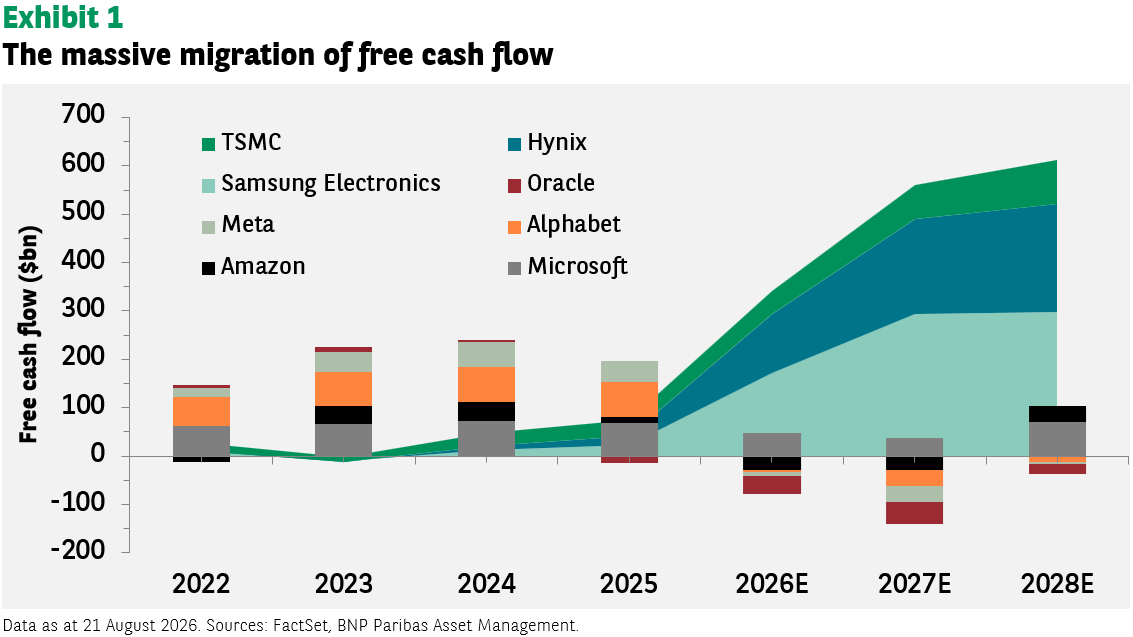
Financial balance sheets clearly show EM corporates as the winners of the current capex build out. We believe this forms the core argument for allocating into EM equities today: a massive migration of cash flow from the spenders to the enablers (Exhibit 1).
By supplying high-bandwidth memory, advanced packaging, substrates and other mission-critical components, Asian hard-tech leaders capture a much larger share of this cash flow while fortifying their balance sheets and enhancing shareholder returns. For example, one of Asia’s market leaders allocates more than 50% of its free cash flow back to shareholders.
Compared to the capital intensity borne by cloud platforms, we see potentially more value in these pick-and-shovel providers. Provided order visibility remains robust (as it has so far) and supply tightness persists, margin profiles across North Asian suppliers should remain firmly supported in the medium term.
Importantly, the opportunity extends well beyond these obvious winners. The first phase of the cycle was dominated by the build-out of computing infrastructure and frontier models. The next phase could broaden into sectors such as power, enterprise adoption, robotics and autonomous systems, each exposed to different supply-demand dynamics and competitive forces. We are already seeing this broadening thematic in the supply chain.

As a result, earnings visibility and margin profiles have improved significantly across the ecosystem (see Exhibit 2), while the respective leaders’ valuations still look attractive, creating a rich hunting ground for active stock selection.
Positioning resets, fundamentals intact
The mid-year market correction across AI hardware – particularly South Korean tech – offered a textbook lesson in market mechanics.
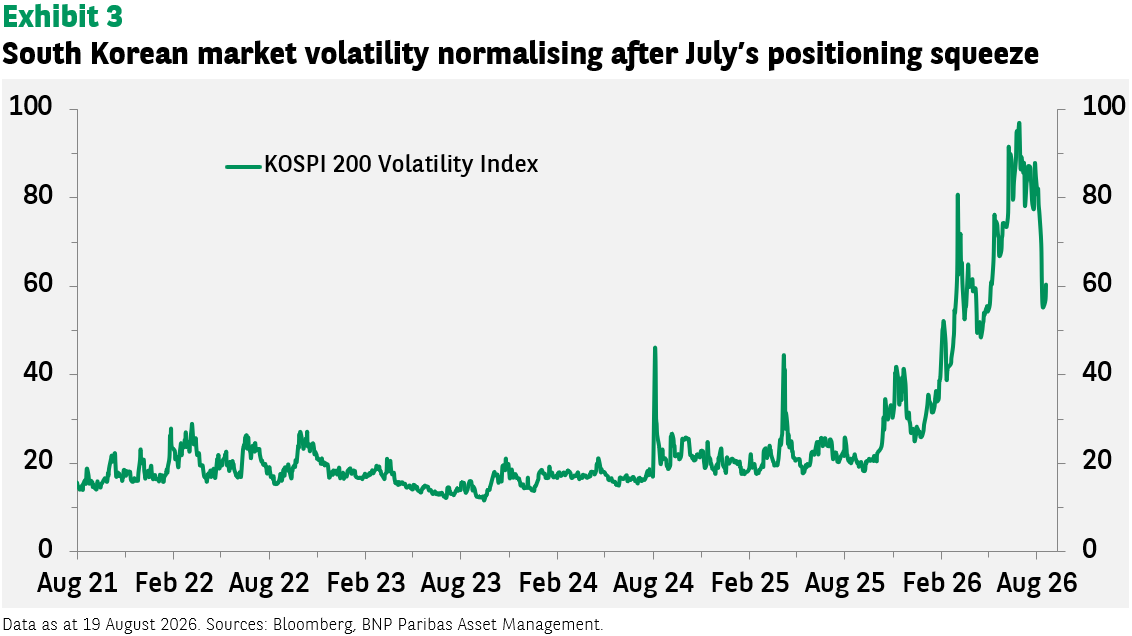
Highly leveraged, crowded single-stock exchange-traded funds (ETFs) and speculative retail flows briefly pushed intraday market volatility higher in July (Exhibit 3). In South Korea, heavy losses in single-stock leveraged ETFs prompted regulatory intervention, including raised margin deposit requirements and stricter collateral rules. The drawdown effectively flushed out part of this speculative froth: assets under management for South Korean leveraged ETFs halved from a peak of $53 billion in June to $26 billion by the end of July.2
We view the sharp July correction as an inevitable but healthy positioning reset. Looking ahead, we expect market volatility to potentially normalise to some extent given a cleaner retail positioning.
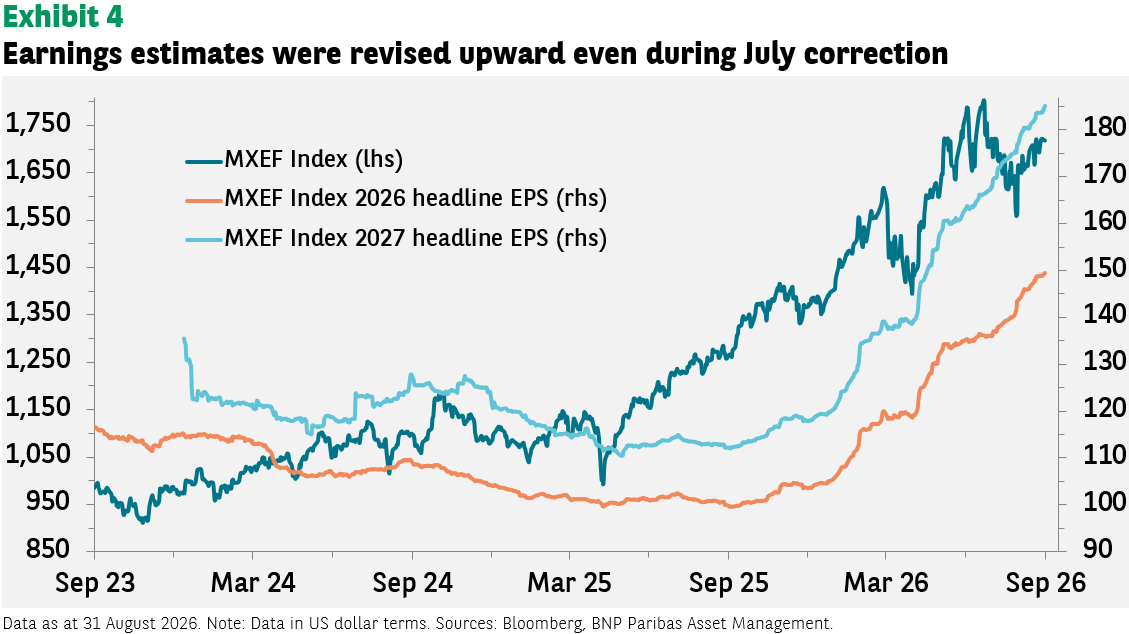
Crucially, the positioning reset was technical, rather than fundamental. Earnings estimates for key EM tech enablers continue to be revised upward. This was also the case during the July correction (see Exhibit 4).
Order visibility across tier-one memory makers and advanced packaging companies remains extended, with capacity booked well into future quarters.
While the initial leg of the tech rally was driven by multiple expansion (perhaps hard to justify for the South Koreans unless we are looking at the price-to-book ratio) and momentum-driven liquidity, the next phase will likely be more driven by earnings execution. For active stock pickers, moving away from broad market beta toward alpha-driven stock selection potentially offers a better approach.
Cheap valuations alone are never enough
EM equities have historically traded at a discount to developed markets. Cheapness by itself is rarely a catalyst; value traps abound without fundamental drivers (Exhibit 5).
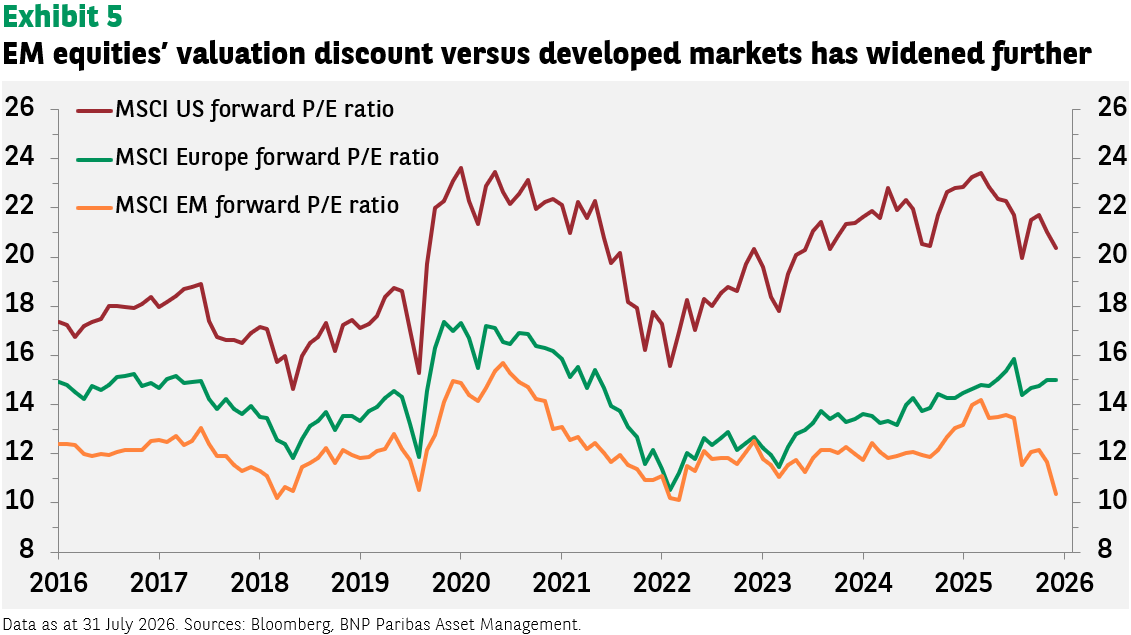
What makes the current setup attractive in our view is the combination of strong earnings momentum, attractive valuations, and the improvement in macroeconomic resilience to external shocks over the past decades.
Reforms since the 2008 global financial crisis have significantly transformed EM resilience. Learning from past vulnerabilities, many EM countries systematically shifted toward issuing debt in local currencies rather than US dollars, eliminating the currency mismatches that historically triggered defaults. Central banks fortified their balance sheets by building vast foreign exchange reserves and adopting credible inflation-targeting regimes.
Consequently, when energy prices spiked, EMs absorbed the shock using flexible exchange rates and timely, independent rate hikes – maintaining market stability and preventing the classic capital flight seen in previous global downturns.
Risks and implications
In our view, the key risks to the asset class are clear: a sharper-than-expected slowdown in US tech capex; renewed energy price volatility; geopolitical friction; and aggressive capacity expansion that erodes pricing power.
The ultimate determinant of tech hardware demand will be the return on invested capital of AI capex. As the cycle matures, investors will likely increasingly focus on where the economics of AI ultimately accrue. Can memory and semiconductor suppliers continue to capture a disproportionate share of the profit pool?
These risks do not invalidate the structural attraction of EM equities; rather, we see them as reinforcing the case for an actively managed allocation rather than foregoing the opportunities EM equities currently offer.
With return dispersion near multi-decade highs, we believe the environment favours a high-conviction, selective approach focused on identifying those companies with pricing power, cash flow visibility and disciplined capital allocation.
[1] Source: FactSet, as of 19 August 2026.
[2] Source: Goldman Sachs, data as of 1 August 2026.


