
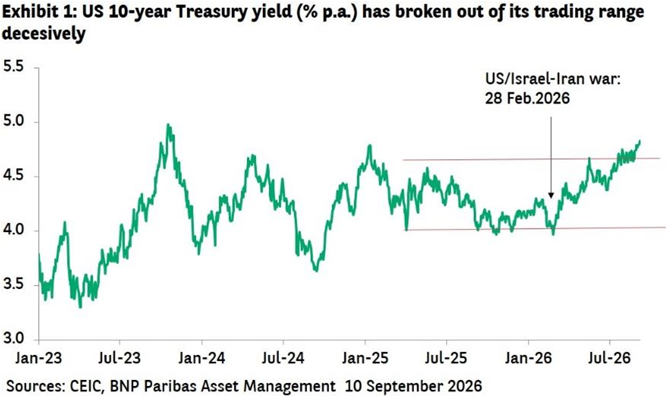
The US Treasury started its operation on buying back long-term bonds on 10 September. Treasury Secretary Scott Bessent announced earlier to triple the size of the buyback to USD6 billion a month, targeting 10- and 20-year bonds. However, the move did absolutely nothing to bring down the long yields as hoped, with the US 10-year yield spiking past 4.83% to the highest levels since November 2023 (decisively breaking through the upper bound of its 18-month trading range, Exhibit 1) and the 20-year yield rising past 5.30%. These yields are now back to the same levels when Bessent came up with the buyback idea to tame the pressure on the long US yields a few weeks ago.
What’s the problem?
While Bessent thought that aggressively buying long Treasuries could tame the long end of the Treasury curve, economic and market fundamentals are strongly working against that outcome. They include rising energy prices prompting sticky, if not rising, inflationary pressures, Trump pressuring the Fed to cut rates thus threatening the Fed’s independence which, in turn, destroys investor confidence, soaring Federal debt and fiscal spending, and declining appetite for US Treasuries due to decaying confidence and creeping dedollarisation.
Treasury can buy USD6 billion or even more bonds and temporarily improve liquidity at the long end. But it cannot fix the underlying problems that have prompted investors to demand higher yields or less Treasuries. A notable example of waning foreign demand is Norway’s USD2.3 trillion Sovereign Wealth Fund, which is cutting its US Treasury holdings from 34.1% in its bond portfolio to 21.9%, or nearly USD80 billion.
Meanwhile, Japanese demand for Treasuries is also declining. The Japanese government has been encouraging the giant USD1.8 trillion Government Pension Investment Fund (GPIF) to invest more domestically, as JGB yields have risen sharply. The fund currently holds more than USD230 billion in US Treasuries, raising the prospect that some of that capital could eventually be repatriated (by selling Treasuries).
The bottom lines
US Treasury is not only fighting domestic inflation expectations and spiralling US debt that spook investors, but also an external battle as rising Japanese yields are making domestic assets more attractive to Japanese investors and risking Japanese capital repatriation spilling over into boosting US yields and borrowing costs.
All this not only means a tough time for long bonds but also a broader negative implication on global risk assets, especially when the Japanese start to repatriate capital through the so-called reverse carry trade.


