
Global interest rates stand at a critical crossroads as sticky inflation, shifting economic data, and energy price shocks split central bank consensus. Adding in geopolitical risks, these crosscurrents have translated into fickle interest rate expectations since late 2025, swinging between rate-cuts and rate-hikes every few weeks. The latest round of rate-hike expectations emerged in mid-June 2026, but the tide seems to be changing again since early August.
Rate hikes expectations…
Despite a series of major negative shocks – from the April 2025 “Liberation Day” tariffs, the ongoing tariff uncertainty, and Donald Trump’s political attacks on the Fed to rising Sino-US tensions and the US-Iran and the Russia-Ukraine wars that have pushed oil prices to USD100/b before retreating to USD80/b recently (it was USD50-60/b before the Iran war) – growth in the major developed market economies, notably the US (but also Europe and Japan), have shown continued resilience.
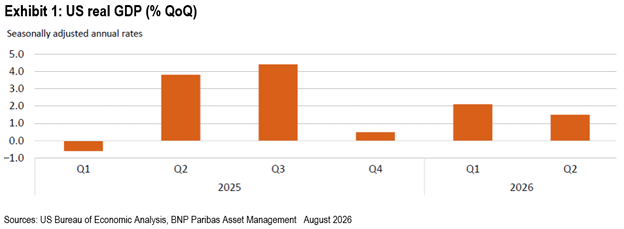
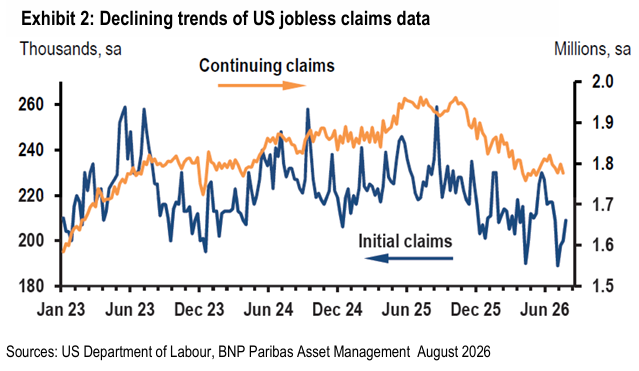
For example, US real GDP grew at an annual rate of 2.1% in 1Q 26, and at an estimated 1.5% in 2Q (Exhibit 1). These rates are close to the US GDP long-run potential growth rate of 2%. High frequency data like the US jobless claims shows a declining trend, despite its week-on-week volatility (Exhibit 2), indicating benign labour market conditions.
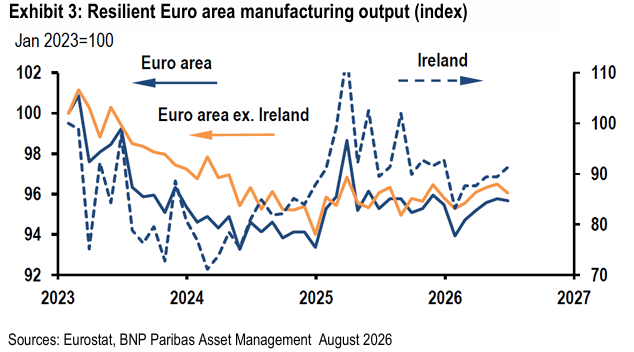
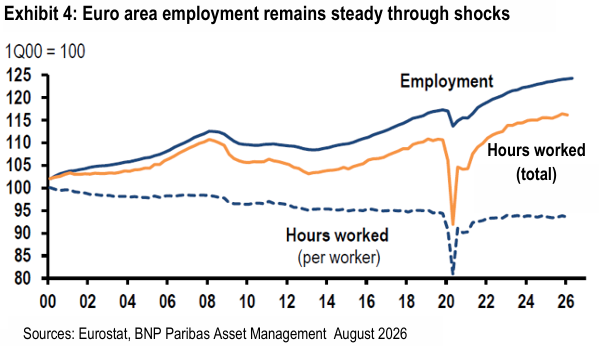
The case is similar in Europe, which is more exposed than many other economies to the energy shock from the Russia-Ukraine war. Manufacturing output in the Euro area (even excluding volatile Ireland – due to its ownership of production facilities abroad) and employment growth have remained steady despite the negative shocks (Exhibit 3 and 4).
So far, strong investment in AI-related data centres, software, and research and development, and consumption spending due to a robust stock market are offsetting the negative growth factors including rising energy prices, higher inflation, fears about rate hikes, and weakening consumer sentiment.
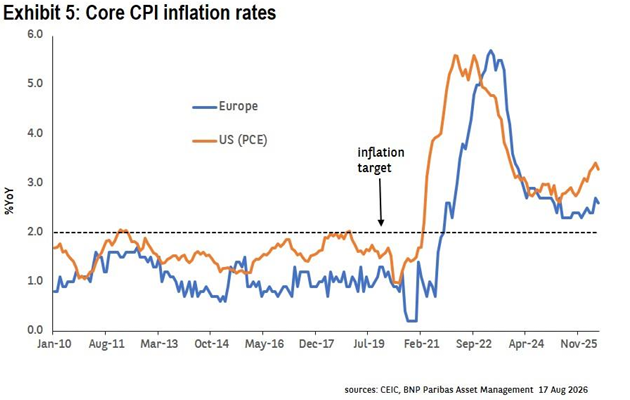
Meanwhile, inflation has remained sticky and above the central banks’ 2% target (Exhibit 5). Resilient growth, above-target inflation, and uncertainty about Fed Chairman Warsh’s policy direction have combined to prompt rate-hike expectations, for now that is.
…Could change again
Market sentiment is very sensitive to shifts in economic data. For example, after the release of US July inflation data on 14 August that showed a small month-on-month decline (but still well above the Fed’s 2% target), Fed rate hike expectations for September faded sharply from more than 60% probability to less than 25%. Before this, weak data on US nonfarm payrolls, household employment, housing activity, and retail sales etc. also served to weaken rate-hike expectations.
The point is that rate-hike expectations could reverse quickly if things go wrong and hurt market/growth sentiment:
- Despite court rulings striking down many of Trump’s tariffs, he continues to defy the court decisions.
So, the tariff threat remains. - The prospects for ending the US-Iran (and the Russia-Ukraine) war remain uncertain. This means the
war damage on growth remains a risk. - China-US tensions are rising again, with the US imposing new tariffs on China in August after China
slapping trade restrictions on some US entities; an escalation of Sino-US tensions cannot be ruled out. - There is also the potential threat from financial markets that could reverse market optimism. The
combination of a richly valued stock market and rising long-term interest rates are toxic to risk assets.
We already saw how pessimism about the immediate returns to AI-related investments could lead to
a sharp drop in AI company share prices, especially when those investments are debt financed and the
cost of debt is rising.
On balance
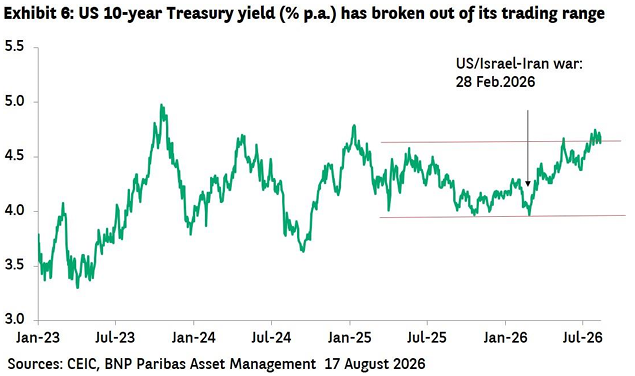
The tug-of-war between the positive and the negative growth forces has manifested in volatile economic data, creating unstable inflation-growth dynamics and, thus, volatile market expectations on the interest rate policy path. The uncertainty has boosted long-term yields (Exhibit 6) as investors ask for a higher term premium to compensate for the uncertainty.
The so-called “crowding out” of the bond markets by the massive Big Tech bond issuance to finance the AI buildout is also competing with US Treasuries, hence contributing to the rise of US long-term yields.
At a 5.3% yield, the 30-year US Treasury bond looks favourable if the Fed can return inflation to its target. But this is uncertain. The Treasury market remains vulnerable to weak sentiment. With inflation risk, the midterm elections, and a new Fed policy reaction function that the market does not understand yet, long yields could move higher in the coming months.
So what?
- Short duration assets are good hedge against these uncertainties.
- High-yield assets, including credits, are another investment option as low odds of recession imply low
macro credit risk and steady income in a volatile market environment. - Unstable expectations, market volatility, and geopolitical risks also favour multi-asset investment tools
for diversifying both risks and returns.


