
The world of finance in two minutes. This week:
The US economy expanded faster than expected in the first quarter of 2026, as the country imported less than previously anticipated. GDP growth was revised up to 2.1% (annualised) from the previous estimate of 1.6%, and a sharp increase from Q4’s 0.5% growth. Additionally, US business activity accelerated in June, the flash Purchasing Managers’ Index showed. The composite, which covers both manufacturing and services, climbed to 52.2 from 51.5 in May – a reading above 50 indicates expansion. Elsewhere, the eurozone flash PMI edged up, albeit to 49.5 from 48.5 as geopolitical concerns remained.
Around the world
Japan unveiled a 14-year ¥370 trillion (US$2.3 trillion) investment plan, its largest and longest-term plan ever, to boost a broad swathe of economic sectors. The scheme includes more than $600 billion of support for artificial intelligence and the semiconductor industry, as well as other areas including defence, shipbuilding and energy. Japan Prime Minister Sanae Takaichi said she intends to create a “strong and prosperous investment framework” for the country.
Figure in focus: 618
China consumer spending remains weak, sales growth during its annual ‘618’ shopping festival showed. During this year’s event, which originated as a single day on 18 June but now spans several weeks, total online sales rose by 4% from a year earlier. This was a significant slowdown from the 15.2% growth recorded in the same period last year, according to reports, citing retail data firm Syntun. Additionally, according to the research, gross merchandise volume – the total value of goods and services – reached 934 billion yuan (US$138 billion), with artificial intelligence a key driver of e-commerce platforms and consumer decision making.
Chart of the week
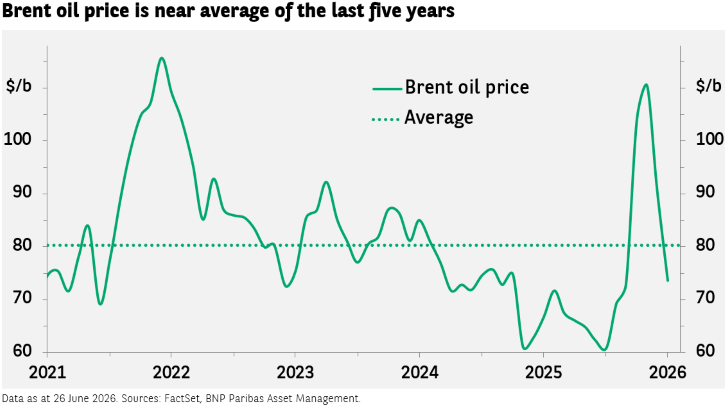
Since the US and Iran agreed a peace deal, oil prices have fallen sharply, easing to around $70-$75 per barrel from a peak of $114 in early May. However, that is still above the $60 low prior to the war. Analysts predict that prices will not return quickly to the lows of earlier this year due to the backlog of ships in the Gulf and damage to energy infrastructure. A somewhat higher price, however, may not be a problem for the global economy, as over the last five years, the oil price has averaged around $80 per barrel.
Words of wisdom
Blue Banana: A banana-shaped corridor running from England, through Europe and down to northern Italy, representing the continent’s main industrial and urban centres. The name was coined by French geographer Roger Brunet in the late 1980s. More than half of Europe’s top 20 economic regions are found within the Blue Banana, according to publisher Visual Capitalist, using data from the European Union and the UK’s Office for National Statistics. The Île-de-France region around Paris is Europe’s most powerful economic centre, generating €866 billion in GDP, followed by Greater London at €713 billion, it said.
What’s coming up?
On Tuesday, Japan issues its latest unemployment figures, and the Reserve Bank of Australia publishes the minutes of its latest monetary policy meeting where the committee voted to leave rates unchanged at 4.35%. The UK also issues a final estimate of its Q1 GDP growth rate. On Wednesday the eurozone publishes a flash estimate for June inflation. The bloc releases its latest unemployment data on Thursday when the US reports jobs numbers. On Friday, final PMI data for June is released including figures covering the eurozone, UK, China, Japan and India.


