
The sell off of major AI infrastructure stocks since late June this year has raised a major investor concern, especially in Asia, about the potential decline in AI/tech spending. The worry arises because strong capex has been a key driving force of Asia’s growth outlook. If US hyper-scaler capex or overall IT capex cycle slows down sharply, that will hurt Asia’s semiconductor and tech capital expenditure.
A manageable risk
However, beyond AI and AI-related digital infrastructure spending, there are structural drivers, including Asia’s renewable-energy transition, energy security investment, and defence spending, driving Asia’s industrial and capital spending. They suggest that the region’s total capex will be many times more than
those of the AI and semiconductor companies.
The market is expecting Asia’s capital expenditure to grow at a compound annual rate of 16% between 2027 and 2031. Reflecting the region’s strong capex are its capital goods imports (a proxy for capital expenditure), which surpassed the 2017-18 peaks in 1Q 2026, and industrial growth indicators, which rose to multi-year highs. Behind this robust performance is strong spending on AI infrastructure, semiconductor manufacturing equipment, and green-energy technology across key hubs like South Korea, Taiwan, Japan, China, and Southeast Asia.
When US AI hyperscalers continue their rapid build-out, Asian chip manufacturers must speed up capex outlays to meet rising demand because Asia is integrated in the global AI supply chain. Meanwhile, in renewable energy transition and energy security spending, China has been the leader, but Asia is lagging behind and must catch up in the face of continued geopolitical and energy shocks. These risks have also made defence spending and energy security investment top policy priorities.
Altogether, AI-enabling, energy-transition-related, and defence investment and capital goods will add to Asia’s policy-driven domestic capex boom, enabling the region to manage a potential AI investment slowdown in the West that the market is worrying about.
Furthermore, Asia’s corporate balance sheets are generally healthy, although regional disparity does exist. Overall, nearly 40% of Asia ex-Japan companies are net cash positive, allowing them to fund expansions via reserves and weather potential global interest rate hikes.
A dividend play
With volatile interest rates, investors are increasingly focusing on reliable sources of income. Asia’s dividend landscape has emerged as an appealing option for those seeking income and long-term growth opportunities and diversification. This is so because of the region’s favourable stock valuations, strong corporate fundamentals, and structural and capital market reforms.
For more than two decades, dividends have been a central pillar of Asia’s investment appeal, accounting for more than half of the region’s total returns (Exhibit 1). This speaks volumes about the regional assets’ income-generating strength.
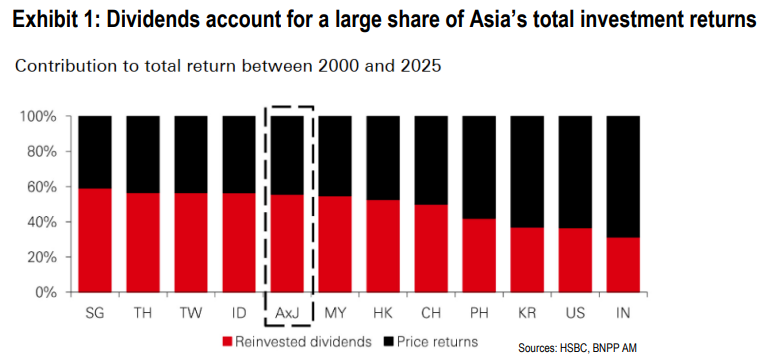
Recent policy initiatives by some Asian governments suggest that using dividends as a way to enhance shareholder returns has grown increasingly compelling. Key efforts include South Korea’s Corporate Value-Up Program, which encourages firms to disclose capital efficiency plans and offers dividend tax incentives, alongside China’s state-owned enterprise (SOE) reforms that tie board performance and market value evaluations to cash returns.


