
By Daniel Morris, Chief Market Strategist
As it turns out, this time the polls were right. If anything, they understated how well the Democratic Party would do across a range of elections. How significant, though, are the implications for US economic growth and asset prices?
One ‘parlour game’ that strategists play is to compare market returns after midterms, or when different parties control the presidency and the Congress. While perhaps entertaining, such analysis has little practical value as it assumes ‘all else being equal’ –that the only variable that is changing is the make-up of the government.
Needless to say, everything else is actually far from equal, from interest rates to GDP growth and inflation, which are far more significant factors for the markets.
In general, what happens in Washington has only a marginal impact on the economy and markets. The exception is when one party controls both the presidency and all of Congress (House of Representatives and Senate).
When that is the case, it is more likely legislation can be passed (such as Obamacare or the One Big Beautiful Bill) that is significant enough to impact, if not the whole economy, than at least particular sectors. When government is divided, the inevitable compromises required to pass legislation means the impact is often less.
This configuration of full, single-party control has recently tended to occur only at the beginning of presidencies, with mid-term elections then giving partial or total control to the opposition party.
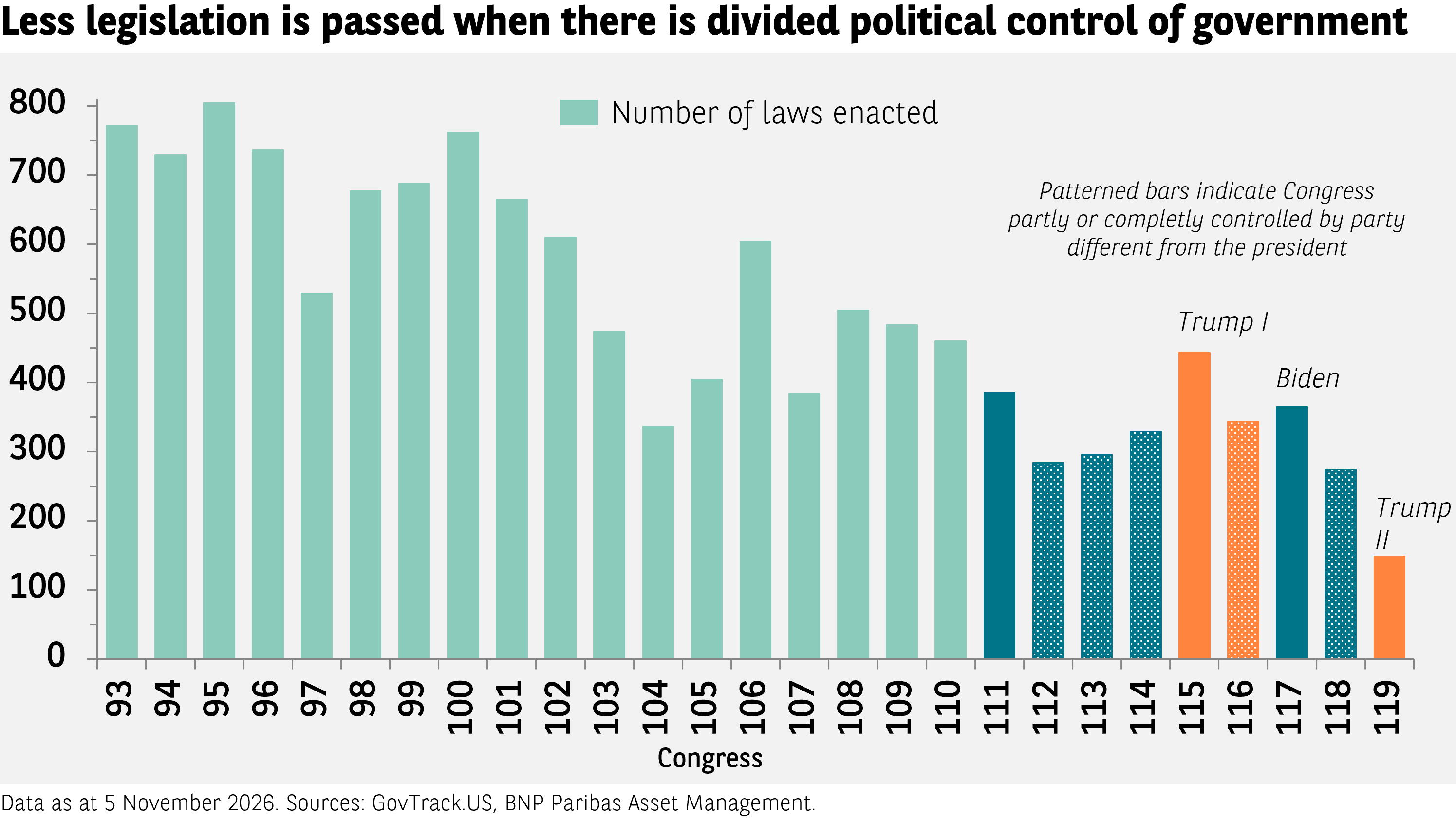
Not only is the legislation passed of less impact when control is divided, there is generally less of it, as compromises generally are difficult to reach.
So, the view that investors had prior to the recent state and local elections should generally still prevail. Our view remains constructive on the outlook for equities as recent macroeconomic data continues to be positive. The third quarter earnings season results were good (if slightly disappointing), and the outlook over the next few quarters is still encouraging. Non-tech heavy indices (like the Russell Value) have tended to move steadily upwards.
The recent tech market sell-off is a continuation of what began in late June. The mid-terms have added an extra bit of uncertainty as investors worry whether data centre buildouts, on which a large of share of expected earnings growth is predicated, will be slowed by Democratic control of governorships and state legislatures.
We expect economic growth to continue more or less as before, regardless of what happens in Washington, which would point to medium-term gains in equities, but with potentially above-average volatility.
Data sources: Bloomberg, FactSet, BNP Paribas Asset Management as of 5 November 2026 (unless otherwise stated). Past performance should not be seen as a guide to future returns.


