
What do you need to know?
Central banks left interest rates on hold last week though inflation concerns exposed divisions among policymakers. The US Federal Reserve maintained rates at 3.5%-3.75%, though three of the 12-member committee opted for a 25-basis-point hike. The Bank of England also kept rates on hold at 3.75%, with three of the nine members voting for a 25bp hike. Additionally, the Bank of Japan held rates steady, at 1%, in an 8-1 vote. Elsewhere, tech-heavy stock markets such as the US Nasdaq and South Korea’s Kospi endured volatility amid concerns over artificial intelligence spending which was offset by strong earnings reports from US tech firms.
Around the world
The eurozone economy grew more than expected in the second quarter, expanding by 0.4% on a quarterly basis, according to an official flash estimate. Analysts had expected growth of 0.2%. Meanwhile, Q1 GDP growth was revised up to 0% from the earlier reading of a 0.2% contraction. Separate data showed eurozone inflation rose to 2.9% in July, up from 2.8% in June. Elsewhere, the US economy grew less than expected in Q2, at an annualised rate of 1.5% – a slowdown from Q1’s 2.1% and less than the 2% the market had been anticipating.
Figure in focus: 15.7%
S&P 500 companies which have reported Q2 earnings so far have seen an average net profit margin of 15.7% for the period, according to FactSet using data as of 28 July – a record level since it began tracking the metric in 2009. The previous record of 14.8% was only reached in Q1 2026. Some seven sectors have reported an increase in net profit margins on a year-on-year basis, led by communication services – which includes several technology giants. Meanwhile, three sectors have seen net profit margins decrease, with healthcare seeing the biggest decline.
Chart of the week
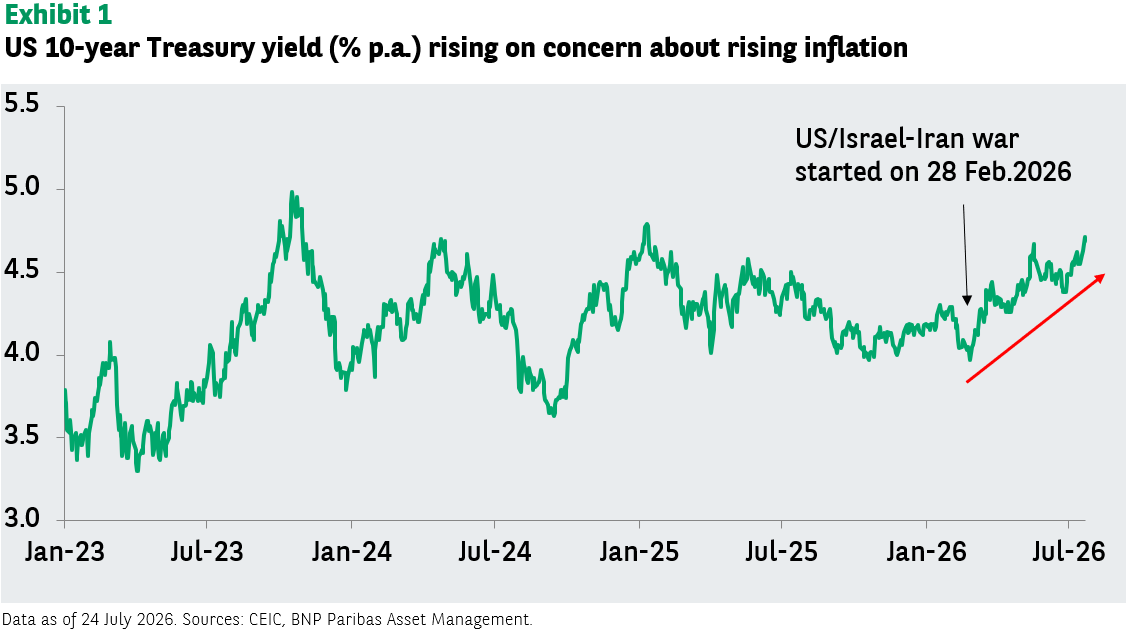
Volatile geopolitical and cyclical conditions suggest inflation, and hence bond yields, may stay higher for longer. Geopolitical disruptions to trade, investment, supply chains, climate change, protectionism, and huge spending on AI infrastructure can all contribute to upside inflation risk. This risk could prompt investors to demand higher bond yields. Investors may also potentially prefer short-duration bonds until the clouds are cleared, due to their typically lower price volatility and quick reinvestment characteristics.
Words of wisdom
Belt and Road Initiative: Launched in 2013, China’s Belt and Road Initiative is a global investment project, aimed at developing infrastructure and trade routes between China and the rest of the world. During the first half of 2026, the programme saw the highest level of first-half engagement since it began, with $49.8 billion of investment and $76.5 billion of construction contracts, according to research from China’s Green Finance & Development Center. Within that, green energy investment and construction contracts reached a record $20.1 billion in the first half of the year, matching 2025’s total.
What’s coming up?
On Tuesday, the US issues import and export figures for June. Wednesday sees the BoJ publish the minutes of its previous monetary policy meeting, while several final composite Purchasing Managers’ Indices are also issued, including those covering the US, eurozone, UK, Japan and China. On Friday, China reports trade figures, while Canada and the US publish their latest job numbers.


