
Record levels of new bond issues are being driven by hyperscalers seeking to finance rapid growth. As well as new opportunities, these issues bring new risks. Investors looking to get exposure should consider a global, unconstrained short duration strategy to help diversify portfolios against these unique risk factors.
Fabien Daguerre, fixed income investment specialist.
Nicolas Trindade, portfolio manager, short duration bonds.
Market analysis from Bloomberg projects that AI-related debt issuance will drive overall investment-grade bond market issuance to record-high volumes in 2026, particularly in the US dollar market, which is expected to surpass the previous peak seen during the pandemic era.
And the trend is likely to continue, supported by increased capital expenditures from hyperscalers, which could reach close to US$1.5 trillion by 2028. In this environment, short duration bonds remain an attractive option to diversify against the risks these new issues bring.
Investor appetite for hyperscalers remains strong
So far, the absorption of AI hyperscaler debt into fixed-income markets has been manageable, with demand significantly exceeding supply. Demand has been supported by elevated all-in yields driven by high sovereign bond yields and the relative price insensitivity of hyperscalers’ issuance, as their primary goal is to deploy capital rapidly to maintain their competitive edge in AI development.
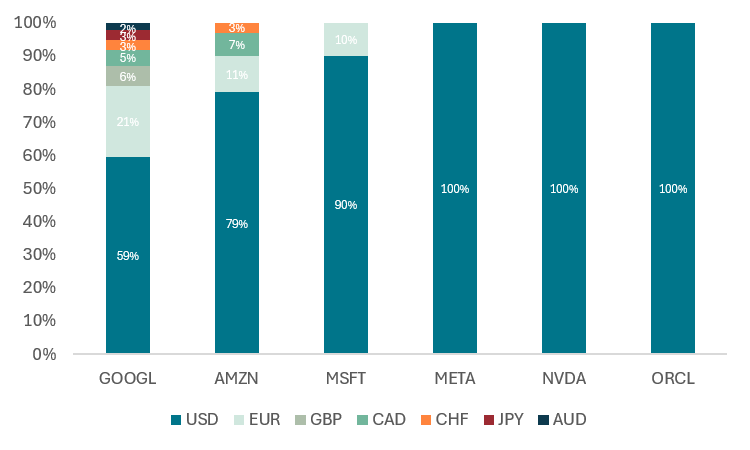
Diversification has also played a key role. Hyperscalers have issued bonds in multiple currencies and have diversified maturities by offering multi-year tranche deals, although the majority of the debt remains long-term.
New issues provide diversified offering
Diversified currencies…
… and maturities (although predominantly long term)
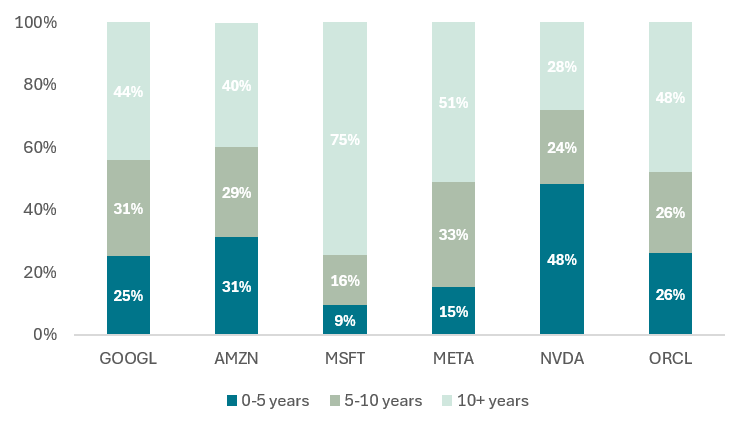
Source: BNPP AM, Bloomberg, 31August 2026. Each hyperscaler issuance is rebased to 100%. Data extracted from the ICE BofA Global Corporate Index (G0BC).
Spreads are trading wider as investors’ concerns increase
Recently, investors’ concerns have increased due to the expected sustained surge in supply, including from AI names with weaker fundamentals and the fact that at some point supply could outpace demand. This has added pressure on existing AI-related debt as investors demand better compensation for taking on supply and fundamental risks. Consequently, AI-related USD credit spreads are currently trading wider than those of non-AI-related debt.
The scale of issuance is reshaping the long end of the US investment-grade market – where most new issues have been made – extending duration and increasing concentration risk. Notably, the large volume of very long-dated debt issued by highly rated hyperscalers is competing with US Treasuries for primary demand. Hyperscalers act as a new government-like debt instrument, pushing US Treasury long-term yields higher and leading to steeper yield curves.
Euro and sterling issues are also impacted, but to a lesser extent
Hyperscalers have also issued in the euro investment-grade market to attract additional investors, albeit to a lesser extent than in the US. Nonetheless, their year-to-date issuance has significantly impacted the long-end part of the market, accounting for more than half of the 15+ year EUR IG corporate index. Similar to the US market, this has extended the duration of the euro investment-grade index and increased concentration risk.
In the sterling market, issuance has been relatively limited so far, with Alphabet’s record £5.5 billion multi-tranche deal. This issuance was well received, supported by favourable technicals and attractive all-in yields.
Key risks on AI-related debt
- Underperformance – Major risks include potential overleveraging if AI adoption slows or demand underperforms, making refinancing difficult and potentially leading to financial stress. Rapid technological advancements could also render existing infrastructure obsolete before debt is repaid.
- Operational challenges – Operational challenges such as shortages of skilled labour, power or supplies could also further delay the infrastructure build-out. Furthermore, market concentration and complex debt structures have increased systemic risk, leading to more vulnerabilities in case of an AI bubble burst.
- Off-balance sheet debt – Beyond listed fixed-income markets, hyperscalers have also accessed less liquid asset classes such as private credit and loans. They have also entered into future lease agreements, contracts not yet initiated, representing future obligations, as well as purchase commitments that will impact future cash flows. Additionally, they may guarantee residual values of data centres if not renewed, creating potential future liabilities that are not recorded as debt.
All these transactions are mainly off-balance sheet, making it difficult to estimate the company’s true leverage and financial risks. The Wall Street Journal recently article pointed to nearly ~$3trn of off-balance-sheet commitments across tech companies, driven largely by data centre leases that have not yet commenced and purchase commitments for GPUs/accelerators, memory, and other semiconductor components.1
Further to these, the anticipated sustained surge in issuance, combined with deteriorating free cash flows driven by higher capex and the risk of supply excess, especially at the long end of the curve, could add further pressure on overall fixed-income markets.
Short duration remains the sweet spot and natural hedge against AI risk
The front-end of fixed-income markets remains attractive, offering high all-in yields without the overhang of AI-related supply. This allows investors to generate elevated and stable income while exhibiting much lower volatility and duration risks relative to longer maturities.
Hyperscalers have predominantly issued longer-dated bonds, with relatively limited issuance in the short end. This provides a natural diversification advantage for short-duration strategies, reducing exposure to hyperscalers’ specific risks.
A global, unconstrained short duration approach to exploit worldwide opportunities and regional market dislocations
Our global short duration bond strategy is in a unique position to benefit from the current heightened market volatility. Truly global and unconstrained, it invests across the full short-dated (< 5 years) fixed-income spectrum. It can significantly alter its asset allocation, investing wherever opportunities are the most compelling with no structural biases, as well as to actively manage its duration exposure across currencies (euro, sterling, dollar) within the 1-3 years range.
A global investable universe offers access to a larger set of issuers across asset classes, regions and sectors, providing more opportunities for alpha generation and better diversification. It is not benchmarked and can therefore be much less exposed to US assets relative to other global strategies.
As at 31 August 2026, the portfolio remains defensively positioned with 22% in cash & sovereign debt, 61% in investment grade credit as we continue to favour the sterling credit market due to more attractive valuations and be cautious on the US with no direct exposure to hyperscalers, and 17% in high-yield & emerging markets with a preference for European high-yield.
[1] Why Big Tech’s AI Spending Is $3 Trillion Higher Than It Seems, WSJ, 16 August 2026.


