
In recent years, fixed income exchange-traded funds have had a major impact on bond markets by providing a liquid investment vehicle in an asset class where many segments were not previously renowned for their liquidity. ETFs achieve this at a cost that conventional mutual funds and other investment vehicles cannot match. Better liquidity offers investors more flexibility through broad exposure to themes or highly specialised, niche ETFs. As a result, ETFs have become an essential implementation tool in asset allocations.
European fixed income ETFs are now a €500bn asset class and have proven an invaluable tool in offering quick, cheap access to all sectors of global bond markets, including those previously difficult to access because of poor liquidity.
The rise of fixed income ETFs
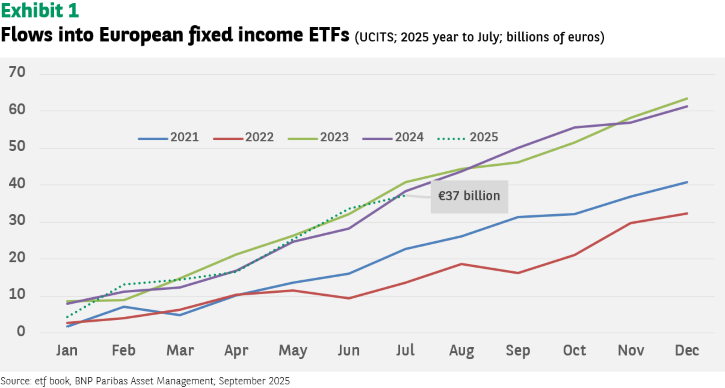
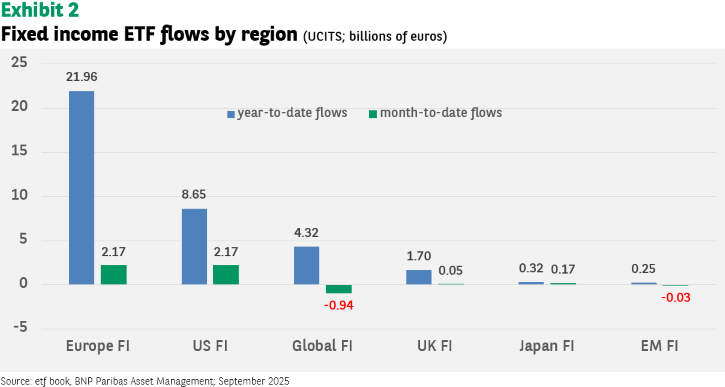
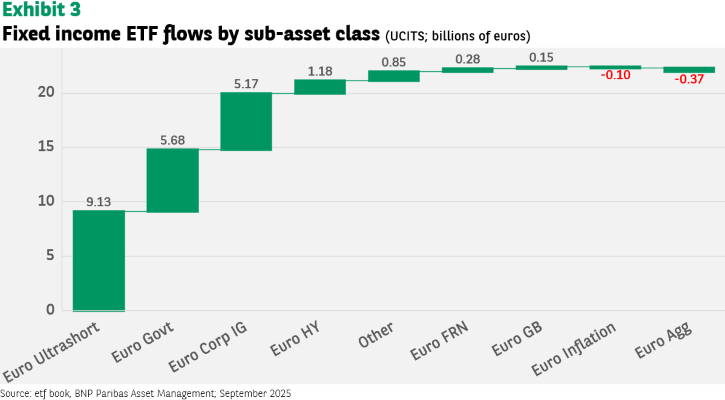
Inflows in to fixed Income UCITS ETFs in 2025 are on track to match the solid 2023-2024 trend, with the first half seeing €37 billion (as of 31 July 2025) in inflows – one of the strongest periods on record. Inflows were mainly into European, lower-risk products.
The growing popularity of ETFs can be attributed to their problem-solving nature and the industry’s response to investor needs. A primary reason is the steady growth in the range of products, which has broadened the investment landscape for bonds.
How to explain the success of fixed income ETFs?
Facilitating market access, allowing for immediate diversification
ETFs have proven to be a invaluable tool enabling investors to easily reach into every corner of global bond markets and achieve immediate portfolio diversification. This had been hard to achieve via direct bond investment: bonds are traded mostly over the counter (OTC), thus inaccessible to non-professional investors and requiring relatively high minimum investment amounts1.
Unlike the equity market, where each public company is represented by a single stock, fixed income markets, and markets in particular corporate bonds, are characterised by a great number of instruments, each with a different profile in terms of size, coupon, maturity, rating, seniority, and legal covenants.
Fixed income ETFs democratise market access by allowing investors to gain exposure to diversified bond portfolios through a single, easily tradable instrument. This levels the playing field, enabling even small portfolios to participate in markets that were once the domain of large institutions.
Bond ETFs are affordable investments
Another aspect, specific to ETFs, is the cost-efficient access they offer investors to bond markets, be they private individuals or large institutions.
ETF fees are low compared to those for traditional mutual funds.
For any investor, minimising the burden of fees is critical, but it is particularly important in bond markets where every basis point matters.
ETFs can be traded intraday
Unlike traditional mutual funds, which can only be traded at their net asset value at the end of the trading day, ETFs are unique in that they can be bought and sold on an exchange throughout the trading session without incurring significant transaction costs.
This feature is particularly valuable during periods of market volatility, allowing investors to respond swiftly to changing conditions and optimise the timing of trade execution.
Delivering lower transaction costs for investors
Fixed income ETFs make this possible in two ways:
- By reducing the bid/offer spread of the investment
- By containing the transaction costs inside the fund itself.
Usually, fixed income ETFs have a tighter bid/offer spread than the average bid/offer spread of the underlying bonds composing the index. This is because individual bond risk is diversified within the ETF, allowing market makers (that is, the bank or broker who prices the ETF on the stock exchange) to trade positions without having to price this specific risk, therefore tightening the bid/offer spread.
This is a characteristic specific to ETFs. It enables investors to implement and change their allocation in a more efficient manner with ETFs rather than through direct investments in bonds.
The advent of fixed income ETFs has facilitated the introduction of new techniques for trading bonds which have reduced transaction costs inside the portfolio itself, leaving a bigger part of the returns to the final investor.
One technique is the ‘in-kind’ creation and redemption mechanisms to optimise execution. It implies the exchange of shares of the ETF for a basket of bonds with the market maker. This eliminates the need of the portfolio manager to invest/divest each flow received by the fund in the market: the bonds are exchanged directly for ETF shares, and the portfolio manager does not need to send market orders.
Portfolio trading is another recent development in the evolution of the corporate bond market that ETFs have facilitated. In a portfolio trade, investors bundle a set of corporate bonds into one basket and execute the entire basket as a single piece of risk, with one broker.
This allows for easier and less expensive transfer of bonds between the fund and the market maker, reducing transaction cost for the fund, therefore benefiting the investor in the ETF.
Portfolio trading only began around 10 years ago. It has grown rapidly because it overcomes the historical constraint on corporate bond liquidity created by a diverse portfolio of bonds, each with a different maturity, coupon, seniority or optionality.
Numerous aspects of corporate bond portfolio management previously required trading many bonds, line by line, to adjust curve, sector or rating exposures. Portfolio trading allows portfolio managers to make these adjustments without trading bonds individually.
Reliable in times of market stress
During market crises, individual bonds can become illiquid or only trade at prohibitively wide bid/offer spreads. ETFs, however, have demonstrated resilience by continuing to trade even when the underlying securities are difficult to trade.
In March 2020, when markets reacted violently to the news of the Covid pandemic, even US Treasury bonds became illiquid for a short time, but ETF shares kept trading despite large volumes of orders and issues in the underlying bond market. ETFs withstood this major stress test.
This reliability enhances portfolio stability and provides investors with a price discovery tool in turbulent times.
The US Federal Reserve’s inclusion of purchases of ETFs in its programme to maintain market stability in 2020 marked an important endorsement for some institutional investors as to the role ETFs can play even for central banks.
ESG Integration
Fixed income ETFs are increasingly being used for strategic allocations and to integrate environmental, social and governance factors into portfolios.
In contrast to equity ETFs, the structure of the bond market allows for significant ESG integration without the fixed income ETF deviating markedly from the risk profile of the non-ESG index.
For example, in a European corporate bond portfolio, we can remove more than 50% of the investment universe to reflect ESG considerations without any major increase in the risk profile of the portfolio relative to the broad benchmark.
We offer a wide range of ESG enhanced fixed income ETFs, including fossil-free and Paris-Aligned Benchmark (PAB) compliant products. These ETFs are based either on index provider research, or they incorporate BNP Paribas Asset Management’s proprietary ESG methodologies and quantitative optimisation techniques.
Investors can choose from various methodologies, including pure index replication, systematic active strategies, and fundamental active approaches.
This flexibility allows for tailored solutions that align with an investor’s investment objectives, their risk tolerance, and regulatory requirements.
Conclusion
Bond ETFs have become a strategic cornerstone of modern portfolio construction. Their liquidity, cost efficiency, diversification, and transparency make them an essential tool in navigating today’s complex fixed income landscape.
As investor demand continues to grow, ETFs are well on their way to becoming the go-to instrument for investing in bonds. Whether used for core allocations, tactical positioning, or ESG integration, fixed income ETFs are a versatile and resilient solution for achieving investment goals in a rapidly changing world.
[1] Generally, at least €100,000-200,000 per security.


