
- Euro fixed income yields have reached levels not seen in over a decade, potentially providing both a stronger buffer against rising interest rates and the chance for better long-term returns
- While volatility remains high, an active and agile approach to duration management can contribute to mitigating risk and enhancing performance
- Given current geopolitical and fiscal uncertainties, we believe a flexible allocation across asset classes – including credit, inflation-linked debt, and sovereign bonds – is beneficial
Europe’s fixed income landscape has undergone significant changes in recent years and become a segment difficult to ignore within the global bond universe.
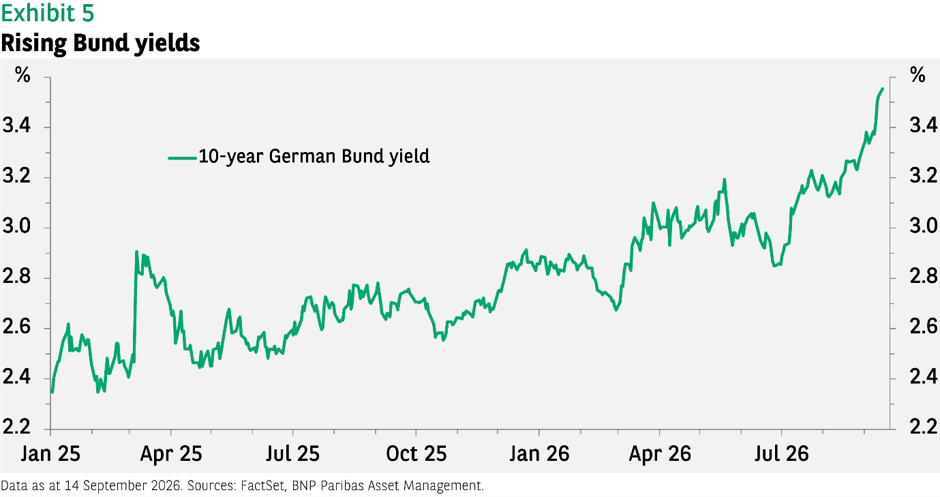
While recent market volatility has sent yields higher – 10-year German bonds are at multi-year highs – we believe this represents a significant opportunity.
Yet these valuations have not been reached by accident. Rising geopolitical risks and subsequent energy shocks have weighed on inflation and central banks’ monetary policies.
Ultimately global fiscal slippage led to higher sovereign debts and deficits. While these factors may still be a source of volatility, we believe investors should not ignore the attractive yield euro-denominated fixed income currently offers, especially when managed with an active, flexible and diversified approach.
Higher yields mean higher potential return
Imagine a 100-metre sprint where competitors start at different distances from the finish line. All being equal, those closer to the end line will enjoy much greater odds of winning.
The same applies to bond markets. While past performance does not guarantee future returns, history has shown nonetheless that higher rates at the beginning of the investing period have generally been associated with higher returns.
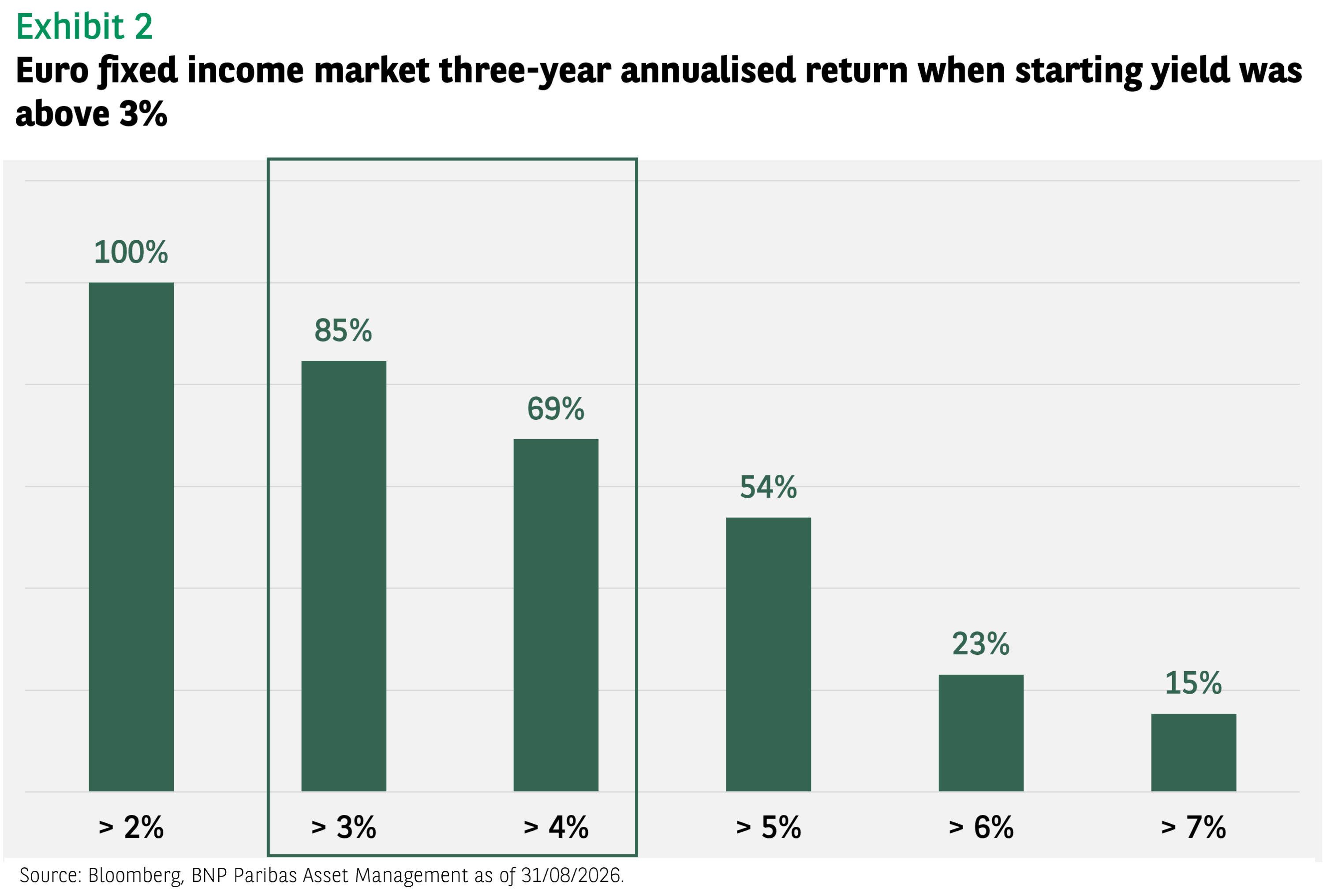
The charts below show how starting yields have been a strong driver of three-year annualised returns for the euro aggregate universe over the past 25 years (Exhibit 1). Actually, when the euro fixed income average yield was above 3% as it is now, the three-year annualised returns have been above 3%, nine times out of 10, and above 4%, seven times out of 10 (Exhibit 2).
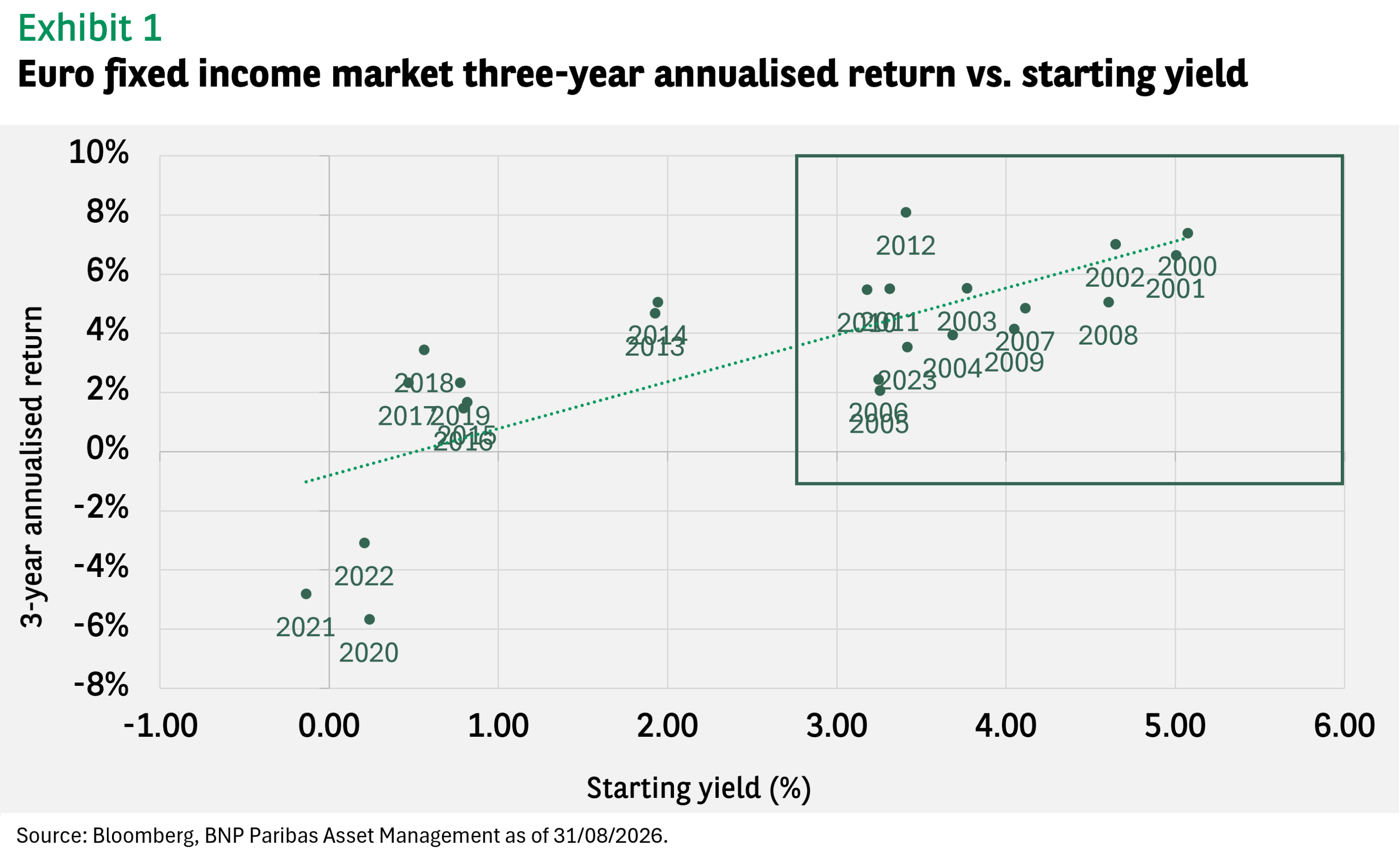
But this is not a surprise: bond market performance over a given period is driven by the starting yield (what we can also call the carry) and the yield’s trajectory over the period. Hence, the higher the yield, the higher the potential performance (provided the rise in yield does not erase that advance).
Indeed, a significant rise in yield could potentially wipe out the entire carry of an investor’s fixed income allocation. Yet again it is quite interesting that over the past 30 years we have had only three cases of negative performance over a three-year period and they all include the 2022 massive bond market sell-off that started from a very low level of yield. There is an explanation for that: higher yields mean a greater buffer against rising interest rates.
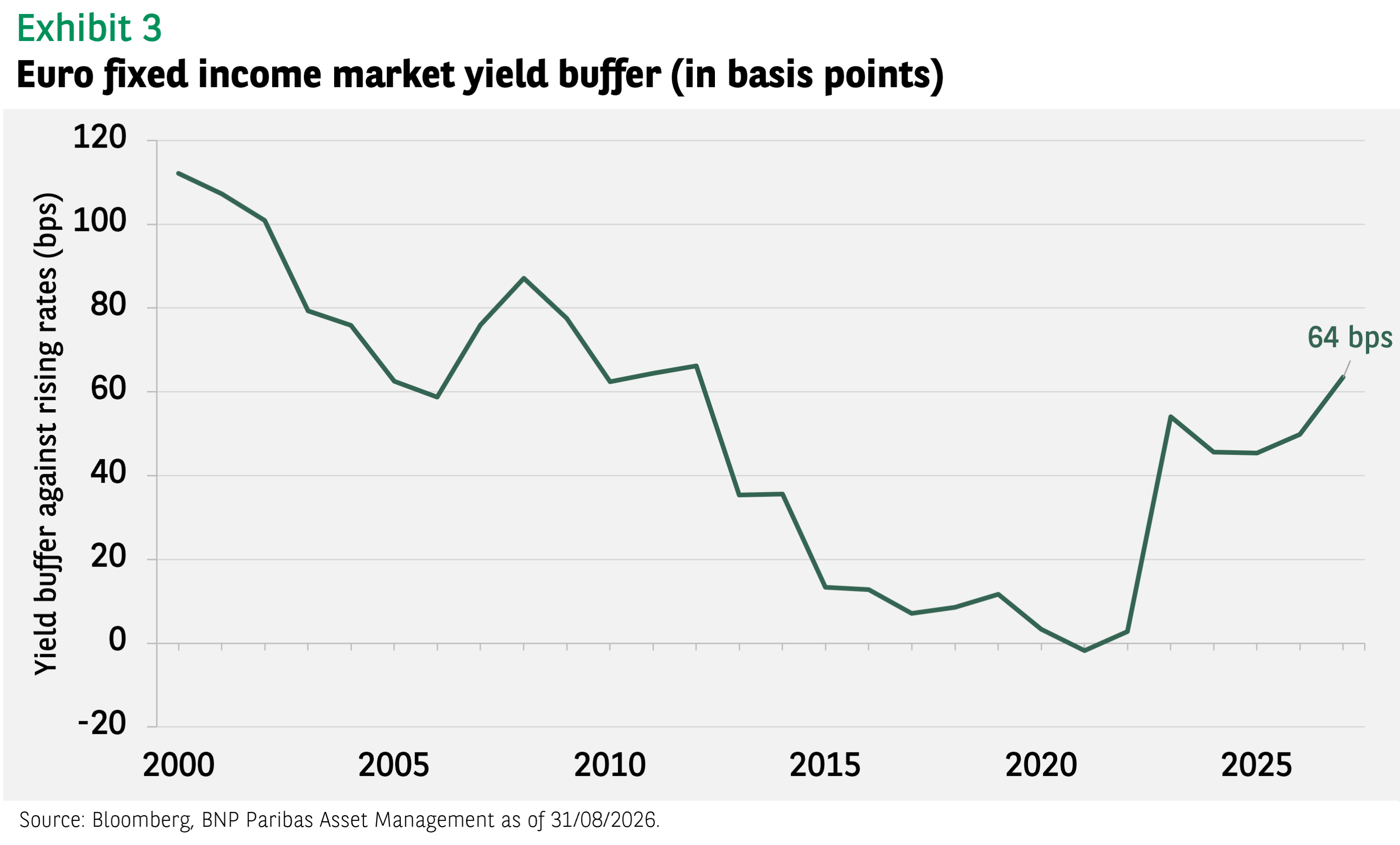
While the quantitative easing era left Europe’s fixed income market without any ammunition against rising interest rates (with the buffer at or close to zero from 2015 to 2022) the recent repricing has reloaded the universe to a level not seen for more than a decade.
Currently, we believe the euro fixed income market can withstand about 60 basis points of rebound in rates before potentially generating a negative return.
Simply put, not only do current valuations provide some buffer against rising rates but they also tend to be associated historically with higher returns.
Higher volatility can be a source of opportunity
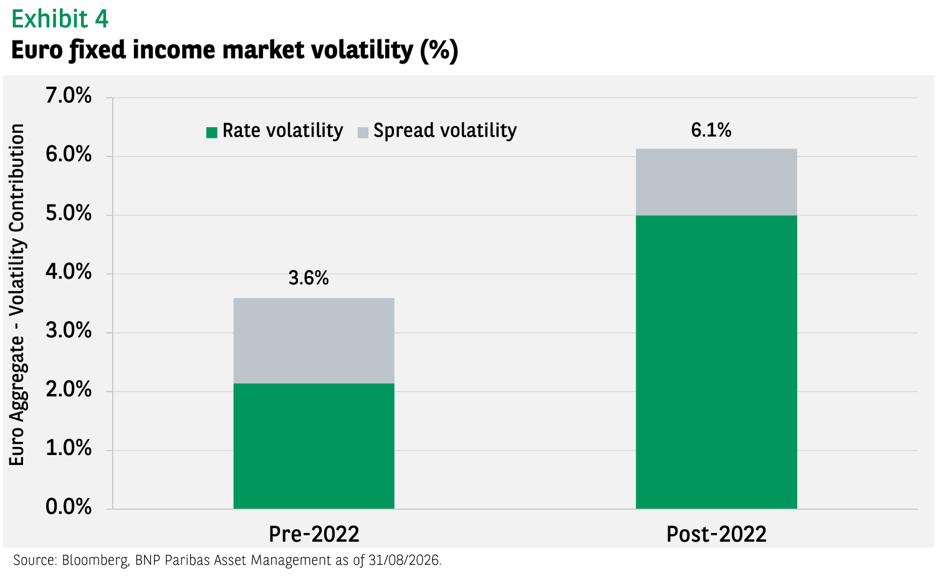
Over recent years, the market has witnessed more volatility, and the current environment should continue to fuel this. Yet it is interesting to note that this new regime of volatility has been driven mostly by interest rates rather than spread volatility.
In other words, rates might be higher but at the expense of higher volatility while tighter credit spreads over recent years have been accompanied by a declining spread volatility.
From a risk-adjusted perspective, this might make current rates valuations less attractive and investors reluctant to take on additional duration risk. But from an active management perspective, we believe such volatility is an opportunity.
Looking at the past year and a half, 10-year German Bund yields have increased by almost 100bp. But taking a closer look at the chart below, there have been eight phases of rates rallying by more than 25bp.
An agile approach with enough flexibility in terms of duration management can aim to take advantage of this volatility, not only to mitigate losses related to the phases of rates rebound but also to enhance return during these periods.
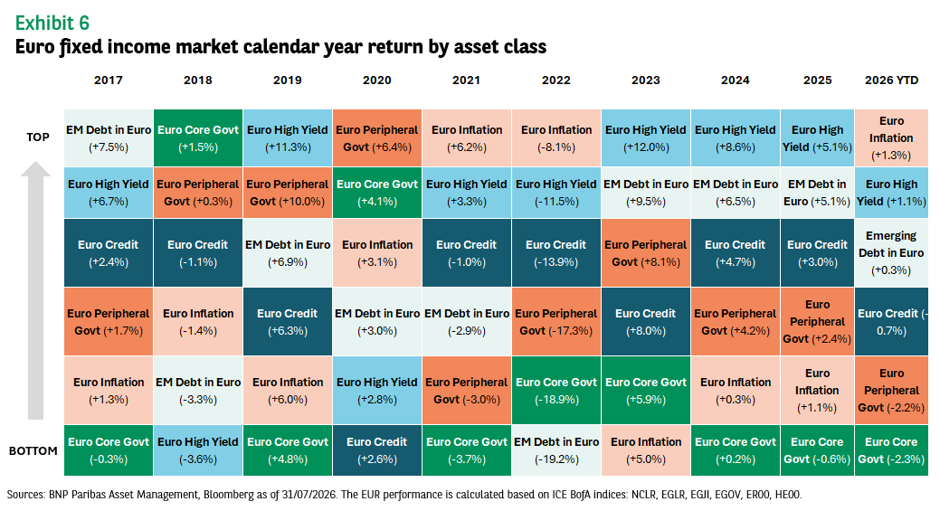
In a period of high uncertainty marked by recurring geopolitical tensions, heavy political agendas, fiscal instability and artificial intelligence expansion, it might be wise to diversify risks.
The euro fixed income market offers access to a wide range of asset classes which, when combined, can potentially help investors navigate different market cycles. Indeed, over the past decade, top performance drivers within the sector have varied from credit to inflation-linked debt, and from emerging market sovereigns to euro core or peripheral sovereigns.
We believe that a flexible allocation across these different drivers has the potential to help investors seize the best opportunities as they arise and subsequently enjoy a better risk-adjusted return.
Holding steady amid instability
Euro fixed income’s appeal may only be rivalled by the current market uncertainty. But as yields keep hitting new highs, we believe the prospects for long term returns improve. Yet, short-term volatility might still unravel investors’ nerves.
Given this backdrop, adopting a flexible and agile approach to duration management while focusing on risk diversification could be the most appropriate way for investors to benefit from (or capture) the euro fixed income opportunity.


