
What do you need to know?
US national debt hit a record $40 trillion last week as the Treasury announced it would double its buybacks of longer-dated debt in a bid to calm volatile bond markets. Inflation concerns and the Middle East stalemate pushed 30-year US Treasury yields to multi-year highs while yields in France, Germany and Japan also spiked; oil prices also rose. Separately, the Federal Reserve’s latest meeting minutes showed policymakers felt interest rates may have to increase if inflation does not ease. They voted to leave rates on hold at 3.5%-3.75% in July, but three of the 12-member committee favoured a 25-basis-point increase.
Around the world
Japan’s economy expanded 1.1% on an annualised basis in the second quarter, a slowdown from the 2.1% seen in Q1 and below the 2% analysts had been expecting. Exports rose more than anticipated, but the growth was offset by weaker domestic demand. Meanwhile, Japan’s annual inflation rate rose to 1.9% in July – its highest this year – and up from 1.6% in June, pushed up by higher energy prices because of the Middle East war.
Figure in focus: 2.9%
Eurozone annual inflation edged ahead to 2.9% in July, up from June’s 2.8%, in line with market expectations. Energy and services costs made the biggest contribution to the increase in July. Core inflation, which excludes more volatile food, energy, alcohol and tobacco prices, grew to 2.5% from 2.4%. Expectations are rising that the European Central Bank will increase interest rates over the coming months as it looks to bring inflation back to its 2% target.
Chart of the week
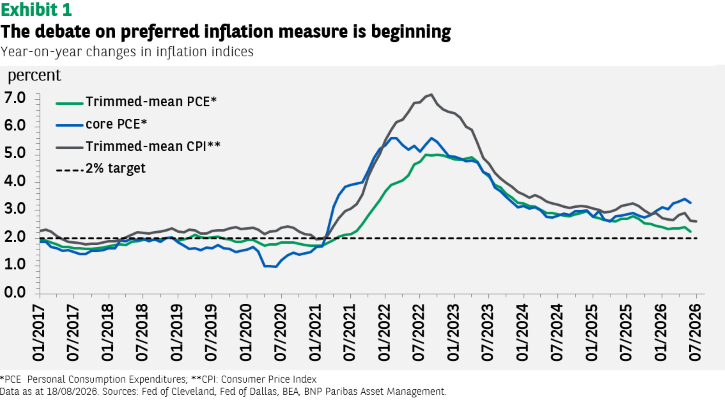
During his April confirmation hearing, new Fed Chair Kevin Warsh described the core Personal Consumption Expenditures (PCE) measure of inflation as “sort of a rough swag” of current trends, and that such approximations are no longer sufficient. He asserted that it is now essential to gauge whether inflation is broadening across the economy rather than being driven by a few specific categories – and identifying better measures of underlying inflation is a key objective for his task forces. This approach highlights the relevance of trimmed-mean inflation measures – which exclude extreme price changes – particularly the Dallas Fed’s Trimmed Mean PCE, which stood at 2.2% in June, compared to 3.3% for core PCE.
Words of wisdom: WAICO
China has established the World Artificial Intelligence Cooperation Organization or ‘WAICO’ – an ambitious global AI development and governance initiative. Announced at a recent conference in Shanghai, it includes 29 member states and is seen as an attempt to rival US technologies and closed models which are too expensive for many consumers in lower income countries. WAICO’s aims include providing a fairer and more equitable platform to share AI development and open-source AI models across the Global South.
What’s coming up?
On Tuesday, Germany publishes its Q2 GDP growth rate and its closely watched Ifo Business Climate index. The US issues a second estimate for Q2 GDP growth on Wednesday – the previous estimate came in 1.5% annualised. The annual Jackson Hole Economic Policy Symposium commences on Thursday; this year’s theme is “Financial Innovation: Implications for Payments and Policy”. On Friday Canada reports Q2 GDP numbers.


