
What do you need to know?
Stocks endured further volatility over the past week, as concerns over corporate spending on artificial intelligence and rising oil prices weighed on sentiment. The MSCI World NR and the US blue-chip S&P 500 indices each fell by 1% in the week to Thursday’s close, while the tech-heavy Nasdaq dropped by a steeper 3%.* Elsewhere, the Dow Jones was up 1% while Europe’s Stoxx 600 was flat. Meanwhile, eurozone fixed income underperformed as US Treasuries rallied. The yield on French government bonds surpassed 5% for the first time since 2002 on uncertainty over the country’s finances – yields move inversely to prices.
*In US dollar terms. Source: FactSet, as of 22 October 2026
Around the world
China’s economy expanded at a faster pace than expected in the third quarter of this year. GDP grew by 4.5% on an annualised basis, up from Q2’s three-year low of 4.3%. Growth was boosted by artificial intelligence-related exports, despite domestic demand remaining subdued and an ongoing downturn in the property market. The quarterly data puts China on track to meet the lower end of the government’s official 4.5%-5% growth target for the year, analysts said.
Figure in focus: 18%
Greenhouse emissions must reduce by 18% by the end of the decade to limit global warming to 1.5°C, the United Nations warned. Current levels of emissions reductions show that under the “lowest possible” overshoot scenario, peak warming will reach 1.7°C to 1.8°C around the middle of the century. To meet the Paris Agreement’s 1.5°C target, “immediate and aggressive cuts” to emissions are needed, of 18% by 2030, 45% by 2035 and 69% by 2040, the UN said. If action is taken, including carbon capture and storage, global warming could return to below 1.5°C by 2100, it added.
Chart of the week
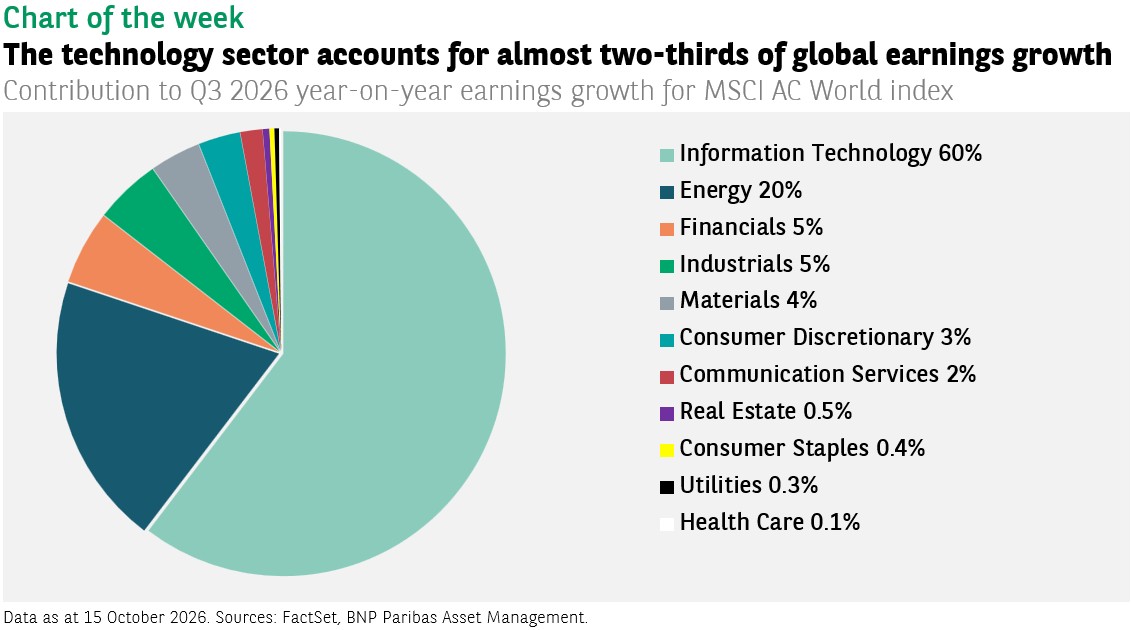
Technology hardware is dominant in driving corporate earnings growth and equity price appreciation. The information technology sector accounted for almost two-thirds of global earnings growth in the third quarter, at 60%, followed by energy at 20%. Expectations are high for technology companies globally, with the sector forecast to see a doubling of earnings compared to the same quarter a year ago, according to the market consensus. Earnings growth in other sectors of global stock markets is relatively low. Investors are keeping a sharp eye on earnings trends, reflecting concerns that stock markets may be overly dependent on the tech sector.
Words of wisdom: Small AI
Task-specific AI models which need less computing power and energy to run. The World Bank launched a new digital strategy to help developing countries improve digital access and services and create more jobs. It emphasised the potential benefits of small AI: tools that are adapted to specific tasks and local conditions, such as helping farmers identify crop disease, supporting health workers, or helping businesses manage inventory. However, substantial barriers remain, with only 23% of people in low-income countries using the internet, the World Bank said.
What’s coming up?
Central banks take centre stage this week. On Wednesday, the US Federal Reserve and the Bank of Canada each meet to make their respective interest rate decisions. The European Central Bank follows on Thursday with its own rate-setting meeting while the Bank of Japan convenes on Friday. Elsewhere, the UK unveils its Autumn Budget on Wednesday. On Thursday, the US publishes its Q3 GDP growth rate, followed by the eurozone which reports Q3 growth data on Friday.


