
Increasingly volatile rainfall patterns are hastening investment in infrastructure that diverts, stores and cleans stormwater, creating opportunities for suppliers of innovative hardware and consultancy services, writes Senior Portfolio Manager Justin Winter.1
Extreme rainfall and more frequent flooding events carry rising human and financial costs. In the five years to 2022, economic losses from global floods totalled $286 billion, up 40% on the preceding five-year period.
Rising incidence and value at risk from floods is expected to drive surging investment in stormwater infrastructure. We believe this will support demand for innovative products and services that help better manage risks to property and life.
It’s a hard rain’s a-gonna fall
Atmospheric water levels are reaching new highs: for every 1°C increase in temperature, 7% more moisture can be held in the air. As well as reinforcing the cycle of global warming – water vapour acts as a greenhouse gas – it magnifies the intensity of rainfall.
Extreme rainfall events previously expected once every 50 years now occur once in five years – and are roughly 20% more intense. In Texas this July, four months of rain fell within a few hours, leading to flash floods that killed at least 135 people and destroyed surrounding areas.
Impermeable surfaces make urban areas particularly vulnerable to the worst impacts. One study found that for every one percentage point increase in the area of US cities’ roads, pavements and parking lots, the annual flood magnitude in nearby waterways increases by 3.3%.
The toll of catastrophic floods in Valencia in October 2024, which cost 0.2% of Spanish GDP and more than 200 lives, was exacerbated by rapid urban expansion.
Adapting urban infrastructure
According to Global Water Intelligence, existing urban water infrastructure falls increasingly short of what is needed to cope with more intense rainfall events.
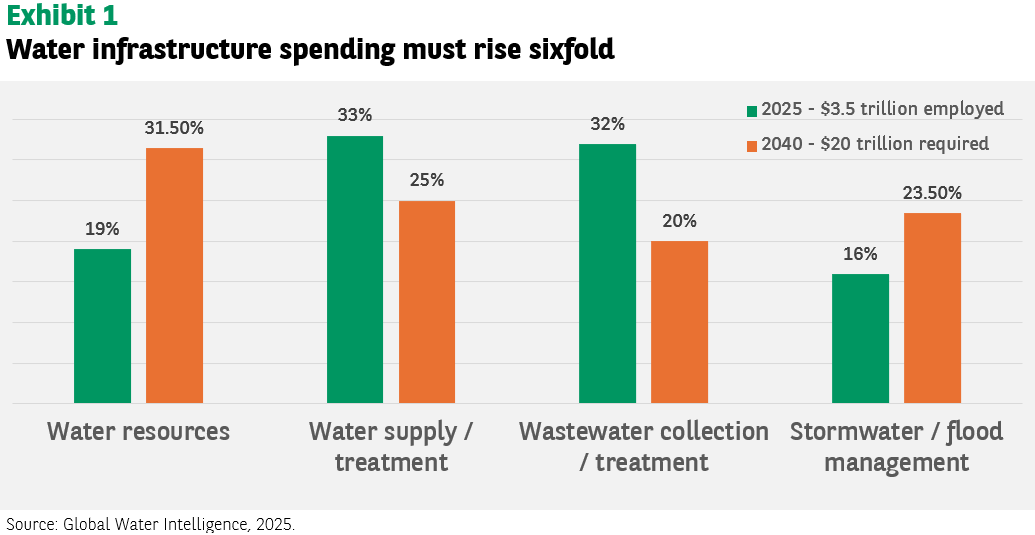
GWI estimates that municipal water infrastructure spending needs to rise sixfold by 2040 to maintain water security levels amid increasingly severe weather. Of the $20 trillion in capital that it estimates needs to be employed by 2040, around $4 trillion would be required for stormwater and flood management (see Exhibit 1).
‘Sponge City’ and advanced drainage
Cities’ need to upgrade water infrastructure to adapt to a changing climate supports demand for the services of engineering consultancies specialising in water management.
Dutch Arcadis, for example, has worked on a project to develop a sustainable urban rainwater management system in Berlin. The ‘Sponge City Berlin’ project aims to protect the city from the impact of flooding using, for example, green roofs, artificial water basins and semi-permeable pavements.
Alongside greater use of nature-based solutions, cities and utilities need to invest in physical equipment to divert and store excess surface water to minimise damage and disruption. Stormwater management hardware includes corrosion-resistant thermoplastic pipes, drainage structures and retention chambers.
As an example, Advanced Drainage Systems offers systems that capture and treat stormwater that often contains heavy metals, oils and other pollutants as run-off from roads and industrial sites, as well as farmland. Capturing these prevents their return into water systems or the wider environment, leaving infrastructure owners who do not take reasonable precautions exposed to penalties.
As the likelihood of extreme rainfall rises, so too will the costs of unpreparedness. We believe that leading suppliers of the hardware needed to divert, store and treat stormwater – as well as consultants designing system-wide solutions – will play an essential role in cities’ adaptation to a changing climate.
[1] This article was previously published by Impax Asset Management @ Stormwater management: adapting to a wetter world – Impax Asset Management


