
By Daniel Morris, Chief Market Strategist
At first blush, there is little to complain about regarding the third-quarter earnings results so far (about half of the companies in the S&P 500 and MSCI Europe have reported). Compared to the third quarter in 2025, profits have risen by 26% for the S&P 500 and by 40%(!) for Europe, with double-digit figures for other major indices, based on data from FactSet (see Exhibit 1). This is well above historical norms.
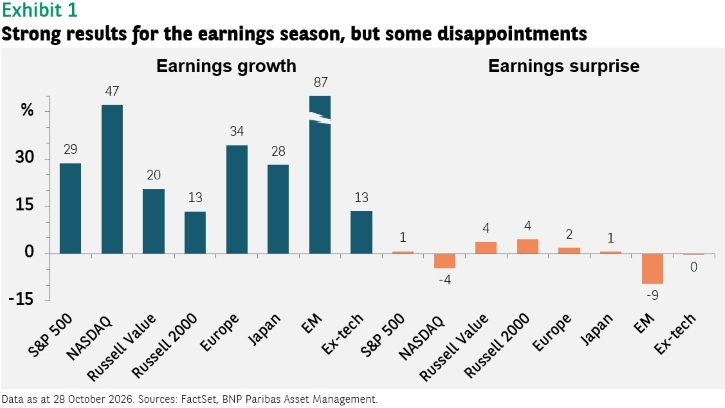
The worry is that those values are not far off what was expected by analysts, and in one case it was below. Earnings have come in only 2% better than expected for the S&P 500. Typically, earnings surprises (how much better or worse results are versus consensus) run in the 3-4% range. Over the previous few quarters, they were even higher. This quarter few indices have matched that.
The chart shows clearly what the source of the disappointment has been: technology. The surprise for the Nasdaq 100 index is -3% and for emerging market (EM) tech stocks it is -8%. The disappointments in emerging markets were almost entirely driven by tech stocks; results for the other sectors were 1% better.
There are two questions: Are these disappointments surprising and how much do they matter?
Given not only how high expectations have been for technology stocks, and how rapidly the artificial intelligence theme is developing, it is not surprising that companies have reported results that are further off the mark than is typically the case.
Though there has been some disappointment in the short term (which will drive the short-term performance of the stock), the more important consideration for investors is the medium-term outlook (which will determine the stock’s medium-term path).
It is worth recalling that consensus estimates for Nasdaq 100 earnings growth in 2027 is 35% and for emerging market technology stocks it is 39%. Even if actual results are a few percentage points lower, and if valuations do not change significantly, indices would typically appreciate in line with earnings.
Sector drivers
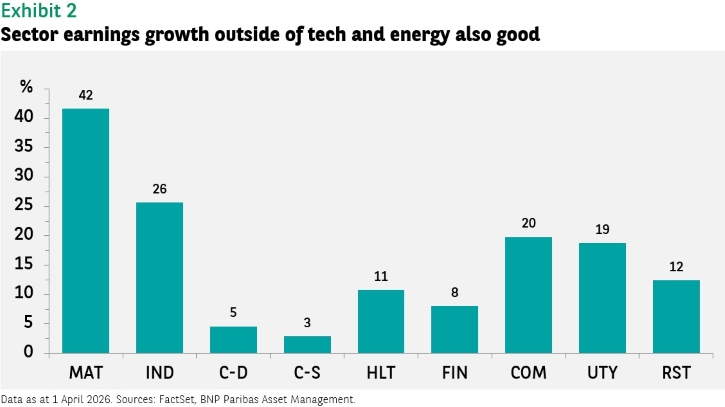
It is not only the tech sector that has boosted EPS (earnings-per-share) growth rates. Higher energy prices have contributed to strong results for indices like MSCI Europe and Russell Value. Excluding the energy sector, earnings growth for MSCI Europe is a (still good) 17%. But even setting aside the gains from tech and higher oil prices, results across other sectors are robust. The automobile industry continues to be a drag on the consumer discretionary sector, but most of the others are seeing high single or double-digit earnings growth (see Exhibit 2).
Whether this broadening in earnings continues, or even accelerates, will partly depend on the rate of adoption of AI technologies. There is already significant anecdotal evidence of companies finding meaningful productivity improvements through AI. One example is insurance companies reducing their claims review times and credit losses by using micro-expression recognition technology.
Stories of CFOs becoming alarmed by high AI bills also suggests adoption is accelerating. This will be critical not only for the future rate of non-tech company earnings growth, but also for the hyperscalers, as they look for the return on their massive capital expenditure.
Performance data/data sources: FactSet, BNP Paribas AM, as of 30 October 2026, unless otherwise stated. Past performance should not be seen as a guide to future returns.


