
By Nathalie Benatia, Senior Market Strategist, Europe
In recent weeks, Federal Reserve policymakers have ramped up their public commentaries at a rare pace. Christopher Waller set a hawkish tone, declaring he would vote for a 50 basis point interest rate hike in December should inflation rise by more than 0.3%.
Other Federal Open Market Committee members, while suggesting that further hikes may be needed given stubbornly high inflation, are advocating for a gradual approach while they monitor how the economy evolves.
The remarks of John Williams, President of the New York Fed, seem to encapsulate the Committee’s stance: inflation remains elevated, and the Fed “must take actions over time that will ensure that we get inflation back to our 2% goal in a timely manner and on a sustained basis”.
Meanwhile, Federal Reserve Chair, Kevin Warsh, this month focused exclusively on the macroeconomic implications of artificial intelligence on productivity and employment. He offered no forward guidance on the future trajectory of policy rates.
Divided opinions
During his confirmation hearings in April, Warsh had criticised the frequency of Fed officials’ public interventions, arguing that providing “truth-seeking is more important than repetition”. He hinted he would limit the number of press conferences following FOMC decisions. Does the recent behaviour of his fellow policymakers signal the start of a rebellion against this approach?
The arrival of a new Fed Chair is typically accompanied by an acclimatisation phase, often marked by communication glitches or misunderstandings. Today, however, the prevailing sense is that many observers have left recent press conferences feeling frustrated since Warsh took office. This sentiment may be driving them to seek information elsewhere to better decipher the Fed’s reaction function.
A brief history
Following Alan Greenspan’s passing in June this year, a well-known quote from him resurfaced: “If I seem unduly clear to you, you must have misunderstood what I said.”
Yet the man who led the Fed from 1987 to 2006 can be seen as the pioneer of modern central bank communication as he frequently commented on his preferred economic indicators to support his narrative.
After Greenspan, Ben Bernanke delivered lengthy speeches – a real treat for economists – and implemented a suite of communication tools. And even before leading the Fed, Janet Yellen saw communication, particularly forward guidance, as a full-fledged instrument of monetary policy.
Following these two economic giants, Jerome Powell performed admirably but will likely be remembered as the symbol of the fight against political interference in central bank management, a fascinating subject in its own right.
Lost in translation?
It is, of course, far too early to assess Warsh’s tenure. However, his desire to keep press releases brief, and more importantly, his brief presentations of the economic outlook, are viewed by some as hindering the interpretation of decisions.
Economists will doubtless attempt to strike a balance between what the Fed should do based on economic fundamentals and what it might actually do. On the latter point, its task is becoming more arduous against a ‘market pricing’ that appears increasingly cryptic.
The market implied probabilities of rate hikes or cuts from Overnight Index Swap (OIS) rates show no sign of a pivot, even over a long horizon, and this trend is not limited to the US. Economists’ forecasts, by contrast, show a more ‘normal’ evolution.
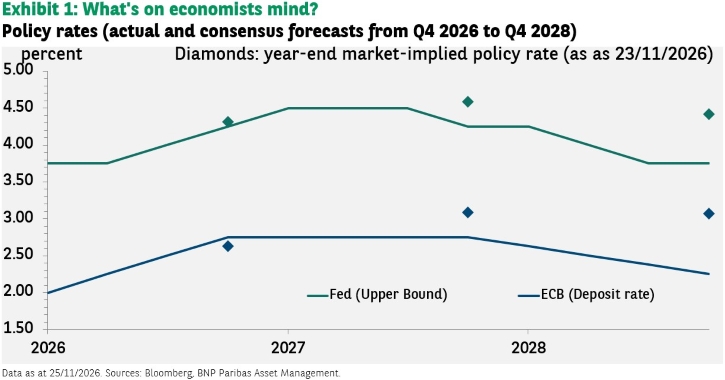
In other words, markets seem to be overestimating the degree of tightness of monetary policy in the coming quarters. One explanation is that the term premium, driving pressure on the long end of the yield curve, is influencing these short-term markets.
Another reason cited is the multiplicity of possible scenarios for the coming years ‘neutralises’ the signal contained in futures markets. Both factors likely play a role, but the latter appears more fundamental.
Indeed, uncertainties regarding the best-case scenario are likely to haunt investors (and central bankers) for some time. This was the core message of Kevin Warsh’s opening speech at a conference this month, in which he examined the economic consequences of ‘super intelligence’, i.e. AI: that its emergence represents a major uncertainty factor in terms of potential growth.
He said: “Our responsibility [at the Fed] is to recognise that the widespread adoption of this technology will have significant impact on the economy, with important implications for monetary policy down the road. The big questions are about magnitude, scope, and timing.”
Implicitly, these uncertainties will likely complicate monetary policy decisions.
Connecting the dots
Every quarter, as part of their economic projections, FOMC members provide their estimate of the ‘appropriate’ rate for the coming years as well as for the long term, which serves as a proxy for the neutral rate – the theoretical interest rate that neither stimulates nor hinders growth. These individual rate projections on the ‘dot plot’, were introduced in January 2012 under Bernanke.
The goal was to enhance monetary policy transparency at a time when rates were near zero. Bernanke, and subsequently Yellen and Powell, repeatedly emphasised that the median of this projected appropriate policy rate should not be viewed as a commitment to a specific rate level.
Despite this, investors continued to over-interpret the dot plot. Warsh refuses to be a ‘dot’ and does not participate in the exercise – a clear statement of his view of the tool.
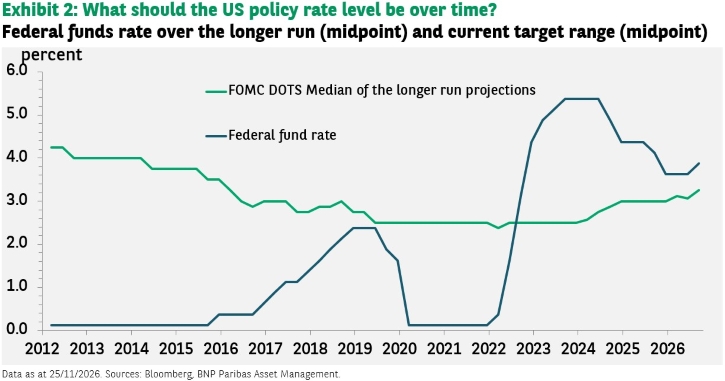
Exhibit 2 shows the median long-term policy rate. According to the latest forecast published in September, it stands at 3.25% (compared to 4.0% in January 2012, which likely reflected the FOMC’s view at the time of 2% potential growth plus 2% inflation, as the neutral rate). In September 2026, the range of projections for the upper bound of the federal funds target rate spanned from 3.0% to 4.0%.
The debate over AI’s influence on the neutral rate is too ambitious to cover here. Let us instead return to the exploration of central bank communication and consider the words of European Central Bank Chief Economist, Philip Lane, in a speech on the science and practice of monetary policy communication.1
In a normal situation (i.e., when policy rates are not zero or negative), Lane advocates for communication that ensures the bank’s reaction function is clear to investors (framework guidance), rather than overly constraining rate forward guidance.
Whatever the communication tool, the credibility and visibility of central bank decisions are the two pillars of effective monetary policy. In our view, everything else is merely a source of volatility for financial markets.
Data sources: Bloomberg, BNP Paribas Asset Management as of 25 November 2026 (unless otherwise stated). Past performance should not be seen as a guide to future returns.
[1] The science and practice of monetary policy communication: the ECB experience


